100+ VPS Hosting Statistics for 2026
VPS hosting adoption continues to rise as website owners and technical teams seek more control than shared hosting provides without paying for an entire physical server. Liquid Web found that 27% of surveyed non-VPS users planned to move to VPS hosting within 12 months, while 90% of current users had recommended VPS hosting or would recommend it.
A virtual private server divides a physical host into isolated virtual environments with assigned CPU, memory, storage, and operating-system resources. VPS products now support websites, online stores, applications, development environments, databases, game servers, automation, and smaller AI workloads.
This article presents 161 VPS hosting statistics covering market estimates, adoption, workloads, operating systems, provider infrastructure, pricing, cloud operations, security, and availability. External source names remain unlinked, while relevant Hyperconvergence resources are linked within the article.
VPS Hosting Statistics at a Glance
- Market Research Future valued the VPS market at $5.58 billion in 2025.
- Liquid Web found that 27% of non-VPS users planned to migrate within 12 months.
- 90% of surveyed VPS users had recommended VPS hosting or would recommend it.
- Root access and uptime were each important to 80% of VPS users.
- Windows Server was used by 36% of respondents in Liquid Web’s VPS study, followed by Ubuntu at 28%.
- OVHcloud reported a 116% increase in entry-level VPS acquisition during the first half of fiscal 2026.
VPS Market Size and Growth Statistics
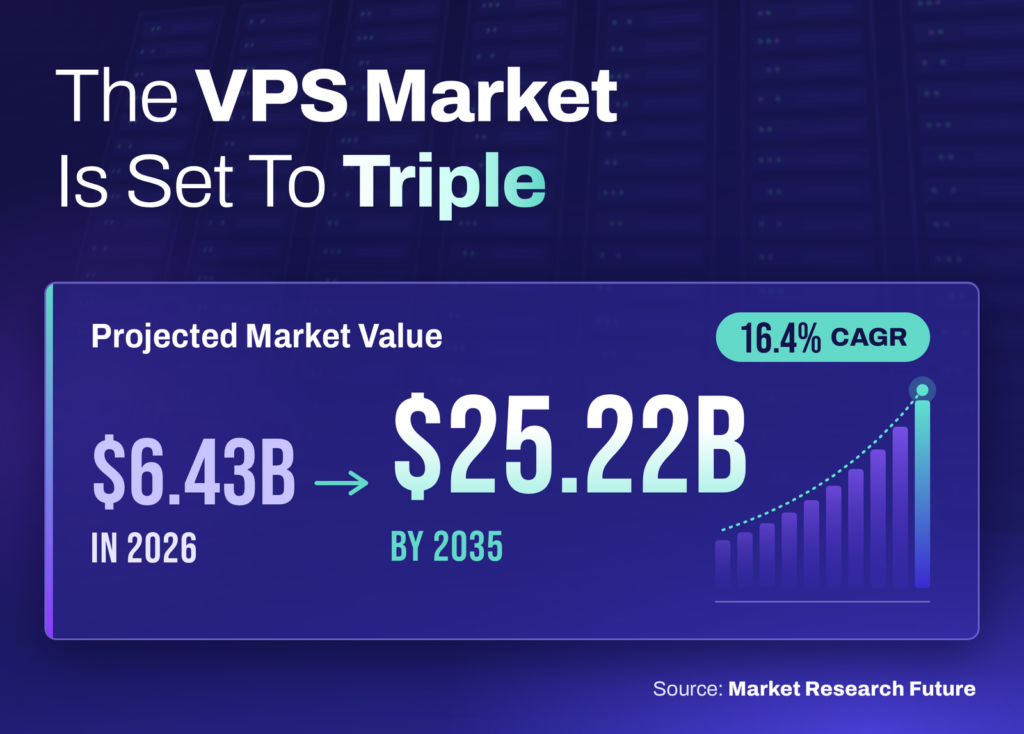
VPS market estimates differ because research firms use different definitions, source sets, and forecast methods. The figures below should be read as separate analyst estimates rather than one audited market total.
- Market Research Future valued the global VPS market at $5.58 billion in 2025. Market Research Future
- The same analysis projected a market value of $6.43 billion in 2026. Market Research Future
- Market Research Future projected that VPS revenue would reach $25.22 billion by 2035. Market Research Future
- Its forecast represents a 16.4% compound annual growth rate from 2026 through 2035. Market Research Future
- Persistence Market Research estimated the VPS market at $5.8 billion in 2026. Persistence Market Research
- Persistence Market Research projected that the market would reach $16.6 billion by 2033. Persistence Market Research
- That forecast represents a 16.3% compound annual growth rate from 2026 through 2033. Persistence Market Research
- IMARC Group estimated that the VPS market reached $5.7 billion in 2025. IMARC Group
- IMARC projected that the market would reach $15.6 billion by 2034. IMARC Group
- IMARC calculated an 11.47% compound annual growth rate for 2026 through 2034. IMARC Group
- The three recent analyst estimates placed the 2025 or 2026 market between $5.58 billion and $6.43 billion, depending on the base year and methodology. Market Research Future, Persistence Market Research, IMARC Group
- Market Research Future expected unmanaged VPS revenue to grow at 17.8% annually through 2035. Market Research Future
- The same firm expected the small and midsize business segment to grow at 18% annually through 2035. Market Research Future
- Asia-Pacific was projected to be the fastest-growing regional VPS market at a 16.9% annual rate through 2035. Market Research Future
- OVHcloud reported a 116% year-over-year increase in customer acquisition for its entry-level VPS offerings during the first half of fiscal 2026. OVHcloud
Hyperconvergence’s web hosting statistics article provides broader figures for shared, dedicated, cloud, and VPS hosting.
VPS Market Share and Regional Statistics

- Managed VPS services accounted for an estimated 63.8% of VPS revenue in 2025. Market Research Future
- Linux-based VPS services represented an estimated 52.3% of market revenue in 2025. Market Research Future
- North America accounted for an estimated 34.5% of the VPS market in 2025. Market Research Future
- Europe represented an estimated 27.2% of the market in 2025. Market Research Future
- Persistence Market Research placed managed VPS at approximately 68.8% of the 2026 market. Persistence Market Research
- IT and telecommunications represented an estimated 35.4% of VPS demand in 2026. Persistence Market Research
- Persistence Market Research placed North America’s 2026 share at approximately 39.2%. Persistence Market Research
- Asia-Pacific represented an estimated 28.5% of the 2026 market. Persistence Market Research
- China accounted for an estimated 39.9% of Asia-Pacific VPS revenue in 2026. Persistence Market Research
- India accounted for an estimated 26.3% of Asia-Pacific VPS revenue in 2026. Persistence Market Research
- Europe represented an estimated 18.4% of the worldwide VPS market under Persistence Market Research’s 2026 model. Persistence Market Research
- Germany accounted for an estimated 34.2% of Europe’s VPS market in 2026. Persistence Market Research
- The United Kingdom accounted for an estimated 25.7% of Europe’s VPS market in 2026. Persistence Market Research
- Managed VPS led the market under all three 2026 analyst summaries that published a deployment-type ranking. Market Research Future, Persistence Market Research, IMARC Group
- Linux held the largest operating-system segment under both Market Research Future and IMARC’s current VPS assessments. Market Research Future, IMARC Group
VPS Adoption and Migration Statistics

Liquid Web collected responses from 951 hosting decision-makers and technical users in July 2025. These results describe that survey population and should not be treated as worldwide market shares.
- Thirty-six percent of Liquid Web’s respondents were using VPS hosting at the time of the study. Liquid Web
- Twenty-seven percent of non-VPS users planned to migrate to a VPS within the following 12 months. Liquid Web
- Forty-four percent of surveyed shared-hosting users planned to move to VPS hosting within 12 months. Liquid Web
- Twenty-five percent of dedicated-server users planned to move to VPS hosting. Liquid Web
- Twenty-five percent of cloud-platform users planned to move to VPS hosting. Liquid Web
- Better performance motivated 42% of respondents who planned to migrate to VPS. Liquid Web
- Lower cost motivated 32% of prospective VPS migrants. Liquid Web
- Security improvements motivated 30% of prospective VPS migrants. Liquid Web
- Ninety percent of current VPS users had recommended VPS hosting or said they would recommend it. Liquid Web
- Among users who had recommended VPS hosting, 61% had recommended it to a nontechnical friend. Liquid Web
- Only 10% of surveyed users considered VPS hosting unsuitable for nontechnical users. Liquid Web
- Sixty-five percent of respondents had learned about VPS hosting through tutorials and online forums. Liquid Web
- Developers and IT professionals represented 50% of the survey sample. Liquid Web
- Small business owners and freelancers represented 31% of the sample. Liquid Web
- Technical hobbyists represented the remaining 19% of the sample. Liquid Web
VPS Workload and Use-Case Statistics

- Nearly half of the surveyed VPS users hosted websites or applications on their virtual servers. Liquid Web
- Twenty-six percent of respondents used VPS hosting for an ecommerce website or online store. Liquid Web
- Twenty-seven percent used a VPS to operate an ecommerce side project outside their primary employment. Liquid Web
- Sixty-three percent of VPS users had used a virtual server for a personal project. Liquid Web
- Fifty-four percent of technical hobbyists had used a VPS to host a game server. Liquid Web
- Thirty-three percent of technical hobbyists had built a game server from the beginning on a VPS. Liquid Web
- Twenty-two percent of technical hobbyists had used VPS hosting for Discord bots. Liquid Web
- Fifteen percent of surveyed VPS users deployed or fine-tuned AI models on virtual servers. Liquid Web
- Performance was the leading improvement request, selected by 35% of VPS users. Liquid Web
- Customization was the main improvement request for 17% of respondents. Liquid Web
- User-interface improvements were the main request for 16% of respondents. Liquid Web
- Among cloud-platform users, 57% listed high prices as a leading frustration. Liquid Web
- Thirty percent of cloud-platform users reported hidden or unpredictable pricing as a leading frustration. Liquid Web
- Among dedicated-server users, 43% listed high prices as a leading frustration. Liquid Web
- Thirty-six percent of dedicated-server users reported poor performance or slow loading times as a leading frustration. Liquid Web
VPS Features, Support, and Buyer Priorities

- Among shared-hosting users, 40% listed high prices as a leading frustration. Liquid Web
- Thirty-eight percent of shared-hosting users cited limited control or configuration options. Liquid Web
- Full administrative control or root access mattered to 80% of surveyed VPS users. Liquid Web
- Uptime guarantees mattered to 80% of VPS users. Liquid Web
- DDoS protection mattered to 74% of VPS users. Liquid Web
- Operating-system choice mattered to 71% of VPS users. Liquid Web
- Scalability mattered to 64% of VPS users. Liquid Web
- Forty-seven percent of VPS users had left a provider because of poor customer support. Liquid Web
- Forty percent had left a VPS provider because of insufficient control or customization. Liquid Web
- Thirty-seven percent had left because of outdated administrative tools. Liquid Web
- Uptime guarantees mattered to 81% of the surveyed IT professionals and developers. Liquid Web
- Full administrative control mattered to 80% of IT professionals and developers. Liquid Web
- DDoS protection mattered to 76% of IT professionals and developers. Liquid Web
- Full administrative control mattered to 80% of surveyed small business owners and freelancers. Liquid Web
- Uptime guarantees mattered to 78% of small business owners and freelancers. Liquid Web
- DDoS protection mattered to 73% of small business owners and freelancers. Liquid Web
- Uptime guarantees mattered to 80% of technical hobbyists. Liquid Web
- Full administrative control mattered to 80% of technical hobbyists. Liquid Web
- Operating-system choice mattered to 71% of technical hobbyists. Liquid Web
- More than half of surveyed users expected email and ticket support to be included without an additional fee. Liquid Web
Hyperconvergence’s cloud server vs. physical server comparison explains how control, hardware responsibility, scaling, and cost differ across virtual and physical infrastructure.
VPS Operating-System and Web-Server Statistics
- Windows Server was the most-used VPS operating system in Liquid Web’s survey at 36%. Liquid Web
- Ubuntu was used by 28% of respondents. Liquid Web
- CentOS was used by 9% of respondents. Liquid Web
- Debian was used by 7% of respondents. Liquid Web
- Arch Linux was used by 6% of respondents. Liquid Web
- Unix-like systems powered 92% of websites with a known operating system on August 27, 2026. W3Techs
- Windows powered 8.2% of websites with a known operating system. W3Techs
- Linux powered 62.2% of websites with a known operating system. W3Techs
- Linux represented 67.6% of known Unix-based website deployments. W3Techs
- Ubuntu represented 15.1% of websites known to use Linux. W3Techs
- Debian represented 5.9% of websites known to use Linux. W3Techs
- CentOS represented 1.2% of websites known to use Linux. W3Techs
- AlmaLinux represented 0.3% of websites known to use Linux. W3Techs
- Amazon Linux and Rocky Linux each represented 0.2% of known Linux website deployments. W3Techs
- Nginx served 31.3% of websites with a known web server in August 2026. W3Techs
- Cloudflare Server appeared on 29.7% of websites with a known web server. W3Techs
- Apache served 22.6% of websites with a known web server. W3Techs
- LiteSpeed served 14.8% of websites with a known web server. W3Techs
- Node.js served 7% of websites with a known web server. W3Techs
- Microsoft IIS served 3.1% of websites with a known web server. W3Techs
Hyperconvergence’s server software guide covers the operating systems, web servers, database services, and management software commonly installed on virtual servers.
VPS Provider and Infrastructure Statistics

- DigitalOcean generated $281 million in revenue during Q2 2026, up 29% year over year. DigitalOcean
- DigitalOcean ended Q2 2026 with $1.125 billion in annual run-rate revenue, also up 29%. DigitalOcean
- DigitalOcean’s AI customer annual run-rate revenue reached $234 million, up 212%. DigitalOcean
- The company added a record $93 million in incremental annual run-rate revenue during the quarter. DigitalOcean
- Incremental annual run-rate revenue grew 191% year over year. DigitalOcean
- Customers spending more than $100,000 annually produced 35% of DigitalOcean’s revenue in Q2 2026. DigitalOcean
- Customers spending more than $500,000 annually produced 26% of revenue. DigitalOcean
- Customers spending more than $1 million annually produced 23% of revenue. DigitalOcean
- DigitalOcean reported $894 million in remaining performance obligations at the end of Q2 2026. DigitalOcean
- The company expected to recognize $366 million of that obligation during the following 12 months. DigitalOcean
- DigitalOcean reported more than 650,000 users in May 2026. DigitalOcean
- DigitalOcean’s May 2026 corporate profile described its footprint as 20 data centers across five global regions. DigitalOcean
- OVHcloud reported operating more than 500,000 servers in its 2026 company profile. OVHcloud
- OVHcloud’s 2026 corporate profile reported 46 data centers across four continents. OVHcloud
- OVHcloud served 1.6 million customers in more than 140 countries. OVHcloud
- OVHcloud’s Public Cloud revenue reached €118.6 million in the first half of fiscal 2026. OVHcloud
- Public Cloud represented 21.4% of OVHcloud’s first-half revenue. OVHcloud
- OVHcloud’s Public Cloud revenue grew 15.1% on a like-for-like basis. OVHcloud
- Vultr made VPS deployment available across 33 global locations in April 2026. Vultr
- Akamai offered cloud compute across more than 25 core regions in its published infrastructure information. Akamai
Hyperconvergence’s top cloud servers article compares major infrastructure platforms that sell virtual compute alongside storage, networking, and managed services.
VPS Pricing and Resource Statistics

Provider prices and specifications below were checked on August 27, 2026. Hosting companies can change plans, regions, taxes, and promotional terms at any time.
- DigitalOcean’s lowest listed Basic Droplet cost $4 per month or $0.00595 per hour. DigitalOcean
- That entry plan included 512 MiB of memory, one vCPU, a 10 GiB SSD, and 500 GiB of transfer. DigitalOcean
- DigitalOcean’s $6 monthly Basic Droplet included 1 GiB of memory, one vCPU, a 25 GiB SSD, and 1,000 GiB of transfer. DigitalOcean
- Its $12 monthly plan included 2 GiB of memory, one vCPU, a 50 GiB SSD, and 2,000 GiB of transfer. DigitalOcean
- Its $18 monthly plan included 2 GiB of memory, two vCPUs, a 60 GiB SSD, and 3,000 GiB of transfer. DigitalOcean
- Its $24 monthly plan included 4 GiB of memory, two vCPUs, an 80 GiB SSD, and 4,000 GiB of transfer. DigitalOcean
- Its $48 monthly plan included 8 GiB of memory, four vCPUs, a 160 GiB SSD, and 5,000 GiB of transfer. DigitalOcean
- Its $96 monthly plan included 16 GiB of memory, eight vCPUs, a 320 GiB SSD, and 6,000 GiB of transfer. DigitalOcean
- DigitalOcean’s CPU-optimized Droplets used a 2:1 memory-to-vCPU ratio. DigitalOcean
- The smallest listed CPU-optimized Droplet cost $42 per month for 4 GiB of memory and two dedicated vCPUs. DigitalOcean
- DigitalOcean’s usage-based weekly backups cost $0.04 per GiB per month. DigitalOcean
- Daily backups cost $0.03 per GiB per month. DigitalOcean
- Backups taken every 12 hours cost $0.02 per GiB per month. DigitalOcean
- Backups taken every six hours cost $0.015 per GiB per month. DigitalOcean
- Backups taken every four hours cost $0.01 per GiB per month. DigitalOcean
- OVHcloud’s current VPS range supported configurations of up to eight vCores. OVHcloud
- The same range supported up to 32 GB of RAM. OVHcloud
- OVHcloud advertised up to 640 GB of NVMe storage for VPS plans. OVHcloud
- OVHcloud’s entry configuration listed one vCore, 2 GB of RAM, a 20 GB SSD, and 100 Mbps networking. OVHcloud
- Vultr advertised cloud VPS plans starting at $2.50 per month. Vultr
Virtual-Server Operations and Cloud-Cost Statistics
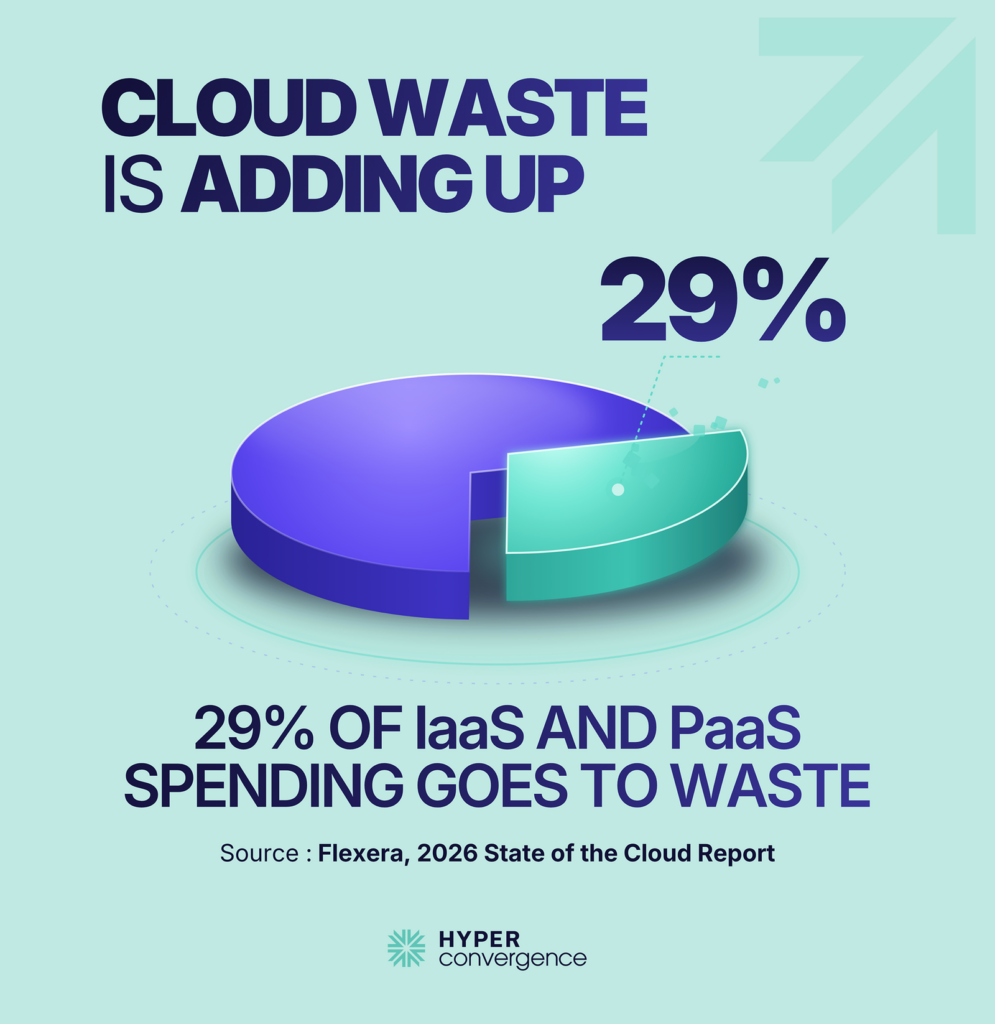
These figures cover public-cloud infrastructure rather than VPS hosting alone. They provide operational benchmarks for teams managing VPS products and other virtual-machine services.
- Flexera’s 2026 State of the Cloud survey included 753 technical professionals and executives. Flexera
- Hybrid cloud was in use at 73% of surveyed organizations. Flexera
- Fourteen percent used multiple public clouds without a private-cloud component. Flexera
- Hybrid cloud was used by 69% of organizations with 5,000 or fewer employees. Flexera
- Hybrid cloud was used by 78% of organizations with more than 5,000 employees. Flexera
- Estimated wasted IaaS and PaaS spending reached 29%. Flexera
- Cloud Centers of Excellence were present at 71% of surveyed organizations. Flexera
- FinOps teams were present at 63% of organizations. Flexera
- Fewer than half of organizations used any single commitment discount option at each cloud provider. Flexera
- Eighty-two percent of container users ran Kubernetes in production in the CNCF 2025 Annual Cloud Native Survey. CNCF
VPS Security, Attack, and Availability Statistics

- GreyNoise recorded 2,969,010,478 malicious sessions targeting internet-facing infrastructure during the second half of 2025. GreyNoise
- Those sessions originated from 3,804,232 unique IP addresses. GreyNoise
- Malicious activity averaged approximately 212 sessions per second across the 162-day study period. GreyNoise
- Previously unseen IP addresses generated 52% of remote-code-execution attempts. GreyNoise
- One hosting provider generated 392 million malicious sessions, equal to 14% of the dataset. GreyNoise
- Cloudflare mitigated 23.2 million network-layer DDoS attacks during the first half of 2026. Cloudflare
- Cloudflare mitigated 29.64 trillion HTTP requests associated with DDoS attacks during the first half of 2026. Cloudflare
- Network-layer DDoS attacks averaged approximately 5,343 per hour during the six-month period. Cloudflare
- Cloudflare mitigated 935 network-layer attacks exceeding 1 Tbps during the first half of 2026. Cloudflare
- Eight hundred and five of those attacks occurred in Q2, representing a 519% increase from Q1. Cloudflare
- A 99.9% availability level permits approximately 8 hours and 46 minutes of downtime per 365-day year. Hyperconvergence calculation
What the VPS Statistics Show
The data points to sustained demand for virtual servers that combine assigned resources, root access, predictable monthly prices, and provider-operated infrastructure. Current market studies place managed VPS ahead of unmanaged VPS, while user research shows that uptime, administrative control, DDoS protection, operating-system choice, and support affect provider selection.
VPS adoption is also spreading beyond conventional website hosting. Developers use virtual servers for application deployment, staging, databases, automation, game servers, containers, ecommerce, and smaller AI projects. This wider workload mix increases the importance of resource monitoring, backups, patching, network protection, and clear upgrade paths.
VPS Hosting Statistics FAQs
What Is the VPS Hosting Market Size in 2026?
Recent estimates place the 2026 VPS market between $5.8 billion and $6.43 billion. Persistence Market Research estimated $5.8 billion, while Market Research Future projected $6.43 billion. The difference reflects separate definitions and forecast methods, so the figures should not be combined.
How Quickly Is the VPS Market Growing?
Current forecasts range from an 11.47% CAGR through 2034 under IMARC’s model to approximately 16.3% to 16.4% under Persistence Market Research and Market Research Future. Every current model reviewed for this article expects double-digit annual growth.
What Percentage of Hosting Users Plan to Move to VPS?
Liquid Web found that 27% of surveyed non-VPS users planned to move within 12 months. The proportion reached 44% among shared-hosting users and 25% among both dedicated-server and cloud-platform users. These percentages describe the study’s 951 respondents rather than the entire hosting market.
What Are the Most Common Reasons for Moving to VPS Hosting?
Among prospective VPS migrants in Liquid Web’s study, 42% selected better performance, 32% selected lower cost, and 30% selected stronger security. Users also valued the ability to install their preferred operating system and change server settings through root access.
Is Managed VPS More Popular Than Unmanaged VPS?
Current analyst models place managed VPS at approximately 63.8% to 68.8% of market revenue. Managed VPS appeals to organizations that want provider assistance with server administration, monitoring, patching, backups, and incident response.
Which Operating System Is Most Common on VPS Hosting?
The answer depends on the dataset. Windows Server led Liquid Web’s VPS user survey at 36%, followed by Ubuntu at 28%. Market Research Future placed Linux at 52.3% of VPS revenue, while W3Techs found Linux on 62.2% of websites with a known operating system in August 2026.
How Much Does VPS Hosting Cost in 2026?
Entry prices vary considerably. Vultr advertised VPS service from $2.50 per month, while DigitalOcean’s lowest listed Basic Droplet cost $4 per month. Managed service, dedicated CPU, backups, control-panel licenses, additional storage, and higher transfer allowances can raise the monthly total.
Which VPS Features Matter Most to Users?
Root access and uptime guarantees each mattered to 80% of respondents in Liquid Web’s study. DDoS protection mattered to 74%, operating-system choice to 71%, and scalability to 64%.
How Much Downtime Does a 99.9% VPS Uptime Level Allow?
A 99.9% availability level permits about 8 hours and 46 minutes of downtime in a 365-day year. A 99.99% level permits approximately 52 minutes and 34 seconds, while 99.999% permits about 5 minutes and 15 seconds. SLA exclusions can change how providers calculate service credits.
When Should a Business Move From VPS to Dedicated Hosting?
A move becomes reasonable when sustained CPU demand, memory use, storage throughput, compliance requirements, or traffic growth exceeds the virtual server’s practical limits. Dedicated hosting also removes competition for shared host resources. Hyperconvergence’s dedicated hosting provider guide covers current physical-server options.
Sources
- Akamai cloud infrastructure and regional availability materials
- Cloudflare H1 2026 DDoS Threat Report
- CNCF 2025 Annual Cloud Native Survey
- DigitalOcean Q2 2026 financial results, pricing pages, and product documentation
- Flexera 2026 State of the Cloud Report
- GreyNoise 2026 Mass Internet Exploitation Report
- IMARC Group Virtual Private Server Market Report 2026-2034
- Liquid Web VPS in 2025 Trends Report
- Market Research Future Virtual Private Server Market Report 2026-2035
- OVHcloud H1 FY2026 results and infrastructure materials
- Persistence Market Research Virtual Private Server Market Report 2026-2033
- Vultr pricing and product documentation
- W3Techs operating-system and web-server usage surveys, August 2026
[…] changing capacity needs. For more context before choosing between these hosting models, review our VPS hosting statistics, including market growth, user adoption, pricing, and common […]