What is Hyperconverged Storage?
Tired of juggling separate servers, networks, and storage arrays? Hyper-converged storage replaces that complexity with a single, software-defined system. Think of it the same way a smartphone merged your camera, GPS, and music player into one device.
The shift is already happening. Gartner projected that the share of enterprises using some form of hyper-converged infrastructure grew from about 30 percent in 2019 to nearly 70 percent by 2023.
The future points toward simplicity, efficiency, and tighter integration. That future is hyperconvergence. In this post, we’ll explain how this all-in-one model is reshaping the modern data center.
What is Hyperconverged Storage?
Hyperconverged storage, a form of software-defined storage (SDS), operates within a broader setup known as hyperconverged infrastructure (HCI). Hyperconverged storage is a system that combines compute, storage, and networking into a single software-driven platform.
Much like a smartphone that brings calling, music, and photography into one device, HCI integrates storage, computing, and networking into a unified platform managed from one place.
Instead of using separate hardware for each function, all resources are pooled together and managed through virtualization. This approach lets organizations run applications and store data on the same cluster of servers, controlled through one management interface.
Key characteristics include:
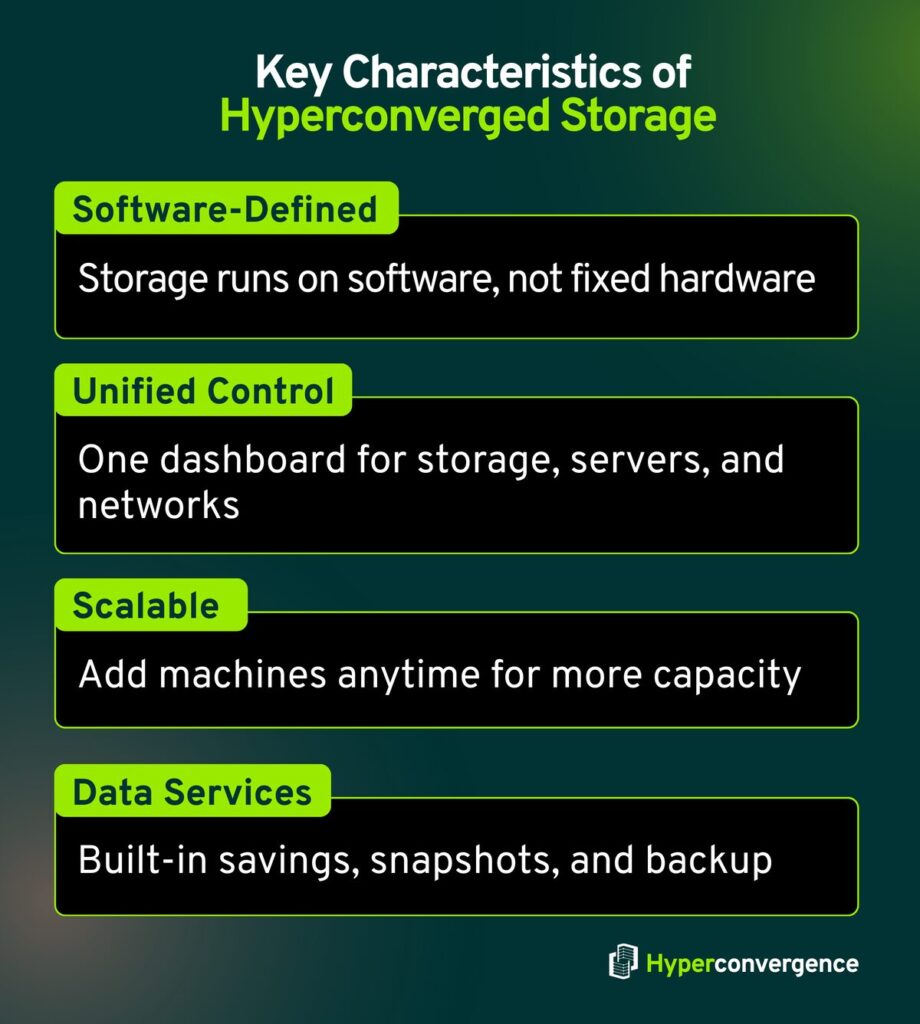
- Software-defined architecture: Storage is handled through software instead of being tied to specific hardware, making it easier to grow and manage.
- Integrated management: One control panel lets admins manage storage, servers, and networks together.
- Scalability: You can add more machines when you need extra space or power.
- Data services: Extra features like saving space, copying data, and backing up are built in.
In short, hyperconverged storage simplifies infrastructure by merging storage functions with compute and networking into a unified environment.
How Hyperconverged Storage Works in HCI?
Hyperconverged storage is central to hyperconverged infrastructure (HCI). Instead of relying on SAN or NAS, HCI pools local disks from each server and presents them as a single shared resource. This makes it an important element of data center management, where IT teams need flexible options to meet changing requirements.
Each server, or node, includes a hypervisor, local storage (SSDs or HDDs), and virtual machines. The hypervisor abstracts hardware, while a software layer combines storage from all nodes into one pool that can be allocated as needed. In some cases, systems even incorporate direct attached storage to provide additional capacity inside the same cluster.
The software-defined storage (SDS) layer adds features such as deduplication, compression, replication, and tiering. It spreads data across nodes for performance and capacity balance, with redundancy to maintain availability if a node fails.

Administrators manage everything through a single interface, handling VMs, storage, and networking resources in one place. New nodes can be added without disruption, making scaling straightforward. This creates an architecture very different from traditional storage arrays, which often require separate management.
In short, hyperconverged storage turns local disks into a resilient, flexible, centrally managed system for modern workloads.
Hyperconverged Storage vs. Converged Storage
| Aspect | Converged Storage | Hyperconverged Storage |
| How it’s built | Servers, storage arrays, and switches are bundled together but stay as separate hardware | Compute, storage, and networking all run on the same hardware |
| Where storage lives | Uses external SAN or NAS systems connected to servers | Uses local disks inside each server, pooled through software |
| Management | Each piece may need its own management tools | Everything managed from a single interface |
| Scaling | Must add large units of compute or storage, which can be costly | Add one node at a time, growing compute and storage together |
| Extra features | Advanced functions often come as separate add-ons | Built-in features like replication, deduplication, and compression |
| Main difference | Hardware stays separate | Resources are combined and delivered through software-defined storage |
Converged storage combines servers, storage arrays, and networking into one package, but each component stays separate. Storage often sits in external SAN or NAS systems, and managing them still requires different tools. Scaling usually means buying another full block of hardware, which can be costly.
Hyperconverged storage takes a different path. It uses the disks inside each node, virtualizes them, and merges their capacity into a shared pool. Compute, storage, and networking all run together on the same hardware, managed through one interface. Adding a node expands both storage and compute instantly, and features like replication or deduplication are built in. This unified design represents a hyperconverged solution that can also support private clouds where integrated compute and storage resources are critical.
In short, converged systems package converged infrastructure, while hyperconverged systems unify it through software.
Benefits of Hyperconverged Storage
Hyperconverged storage has become a go‑to choice for organizations that want to simplify IT operations while gaining efficiency and resilience. Below are the key components that make this approach stand out:

1. Simplicity in Management
Traditional setups force administrators to juggle separate storage arrays, servers, and networking gear. Hyperconverged storage consolidates all of these into a single platform with one management interface. Recent data shows that more than 74 percent of enterprises have shifted one or more workloads from traditional SAN or NAS systems to HCI, and nearly 57 percent now run mission‑critical applications on hyperconverged systems. This unified setup cuts the time spent switching tools and troubleshooting across systems. (Connection.com)
2. Easy Scalability
Growth no longer demands wholesale hardware overhauls. You simply add a node to the cluster, and both compute and storage expand together. This modular approach prevents overbuying resources. That matches market trends, forecasts place the global market for hyper‑converged infrastructure at USD 16.72 billion in 2025, with expectations to climb to USD 51.22 billion by 2030, growing at a CAGR of about 25 percent. Such projections reflect strong confidence in HCI’s incremental scalability. (Mordor Intelligence)
3. Built-in Data Protection
Hyperconverged systems distribute data across nodes, keeping workloads available even if hardware fails. Features like replication, deduplication, compression, snapshots, and integrated backups further protect data while conserving storage.
4. Stronger Performance
Applications benefit from intelligent data distribution, flash-tier integration, and optimized software-defined paths. Virtual desktops and high-demand applications run smoother. Pre-configured systems speed up rollout—teams move from planning to production in hours rather than days.
Disadvantages of Hyperconverged Storage
Hyperconverged storage simplifies operations and offers strong benefits, but it also comes with trade-offs that IT teams should weigh before adopting it across the board.

1. Vendor Lock-In
Most hyperconverged platforms tie customers to a single vendor’s ecosystem. Once workloads and data are integrated, switching providers can become both costly and complex. This limits long-term flexibility and makes future migrations harder to plan.
2. Performance Constraints
For typical virtualized workloads, hyperconverged systems perform well. However, environments with high-performance computing or large-scale AI training may exceed what the architecture can comfortably support. Without careful design, bottlenecks can slow down critical applications.
3. Migration Challenges
Moving from a traditional setup into a hyperconverged infrastructure requires detailed planning. Shifting data in and later out, of these platforms can be time-consuming. While clusters scale easily, they may not match the extreme storage capacity offered by large SAN systems.
4. Cost and Complexity
Upfront costs can surprise organizations, and the added software layer demands new expertise. Since compute and storage are tightly linked, IT teams often need to adjust their workflows and skill sets to manage the environment effectively.
Use Cases For Hyperconverged Storage
Hyperconverged storage brings compute, storage, and networking into a single system. Its flexibility and efficiency make it well suited for a range of business needs, especially when IT leaders want the right HCI solution for growth and modernization.
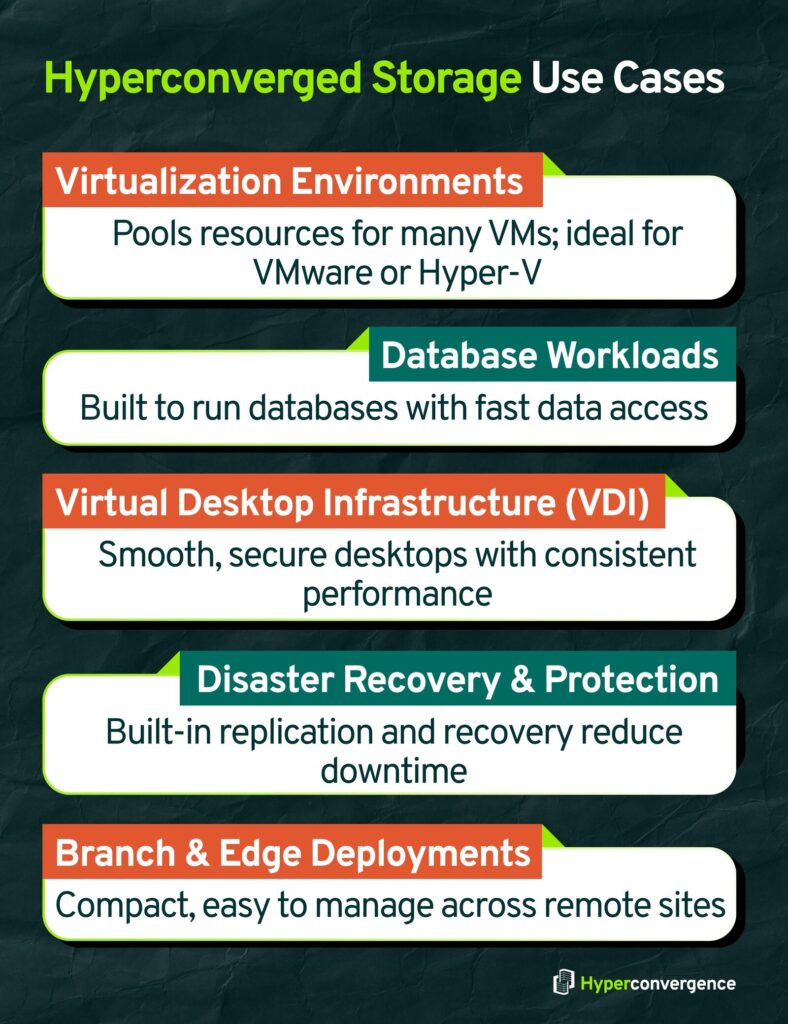
1. Virtualization Environments
Hyperconverged storage is effective in virtualization-heavy settings. It simplifies the operation of many virtual machines by pooling resources and allocating them dynamically, removing the need for external arrays. This makes it ideal for organizations that depend on VMware, Hyper-V, or similar platforms.
2. Database Workloads
Vendors offer hyperconverged appliances specifically designed for databases. These integrate compute, storage, and networking to handle the high I/O demands of transactional systems.
3. Virtual Desktop Infrastructure (VDI)
Centralizing desktops and applications allows IT teams to give users reliable access while maintaining control over updates, backups, and security policies. Hyperconverged storage helps maintain consistent performance even during login storms.
4. Disaster Recovery and Data Protection
A single storage pool simplifies replication and recovery across nodes. This reduces downtime when outages or hardware failures occur.
5. Branch Offices, Remote Sites, and Edge Deployments
Hyperconverged systems provide a compact footprint and centralized management. IT teams can oversee multiple sites without needing specialized staff on location. This is valuable in industries such as manufacturing, retail, and hospitality, where support for point-of-sale systems, ERP platforms, and customer-facing applications is critical.
Hyperconverged Storage Vendors and Products
The hyperconverged storage market has matured quickly, with several major vendors offering HCI platforms that bundle compute, storage, and networking into one system. Each brings its own strengths, but they all share the same core principle of software-defined integration designed to deliver cost savings and efficiency.
- VMware delivers hyperconverged storage through vSAN, tightly integrated with the vSphere virtualization platform. It pools local disks across servers and provides enterprise-grade data services such as replication, encryption, and compression, all managed within the VMware ecosystem.
- Nutanix is often credited as a pioneer in hyperconvergence. Its platform provides storage, compute, and virtualization in one solution, with strong support for hybrid and multi-cloud deployments. Nutanix Prism offers a centralized console for management, making it easier for administrators to scale and monitor clusters. This is one of the most recognized HCI solutions on the market.
- Hewlett Packard Enterprise (HPE) offers HPE SimpliVity, designed with built-in data protection features and strong performance for remote and branch offices. SimpliVity integrates backup, replication, and deduplication, reducing the need for third-party tools and running effectively on commodity hardware.
- Dell Technologies markets VxRail, developed in partnership with VMware. VxRail is a turnkey appliance that integrates with VMware vSAN and vSphere, offering scalability and support for hybrid cloud strategies.
- Scale Computing focuses on simplicity and smaller-scale deployments with its HC3 platform. It is widely used in edge environments, remote offices, and mid-sized organizations that need cost-effective, easy-to-manage infrastructure.
Other notable players include Cisco HyperFlex, Lenovo ThinkAgile HX, and Microsoft Azure Stack HCI, each targeting different workloads and organizational needs.
Together, these vendors give organizations a range of choices, from enterprise-scale deployments to compact edge-focused clusters, all built around the promise of simplifying infrastructure with hyperconverged storage.
FAQs
Hyperconverged refers to an IT architecture where compute, storage, and networking are combined into a single, software-driven system. Instead of running separate servers, storage arrays, and network devices tied to traditional infrastructure, resources are pooled together and managed through one platform. This unification of storage and networking with compute helps organizations operate with fewer silos.
HCI stands for Hyperconverged Infrastructure. In storage, this means local disks from multiple servers are virtualized and combined into a shared pool, often configured as a single cluster. This model delivers high availability while replacing the need for traditional SAN or NAS systems.
Popular hyperconverged storage products include VMware vSAN, Nutanix, Dell VxRail, HPE SimpliVity, Cisco HyperFlex, Lenovo ThinkAgile HX, Microsoft Azure Stack HCI, and Scale Computing HC3. Each delivers storage, compute, and networking as one integrated solution, reducing complexity compared with multi-vendor stacks.
Hyperscale NAS (Network Attached Storage) is a large-scale storage architecture built to handle massive volumes of unstructured data across distributed systems. It is designed to scale out horizontally, meaning capacity and performance grow by adding more nodes. Hyperscale NAS is often used for analytics, media storage, backup, and workloads that demand petabyte-level capacity. Environments that require highly secure data storage also rely on hyperscale NAS to protect sensitive information at scale.
Storage resources from each server (node) are pooled together and managed virtually through a centralized platform. This allows the system to scale and operate as a single unit, with the option to add additional resources when workloads expand.
It offers simplified management, scalability, better resource utilization, reduced hardware complexity, and lower operational costs. Many companies adopt HCI to support both core data centers and remote sites with the same efficiency.
Traditional systems separate compute and storage. Hyperconverged storage tightly integrates both, using commodity hardware and software-defined controls for more agility. Unlike traditional storage, this model consolidates compute, storage, and networking into one platform.