Best HCI Solutions for Mid-Market Companies in 2026
Mid-market IT companies need infrastructure that can grow without turning day-to-day IT into a bigger burden. That’s why the search for the best HCI solutions for mid-market companies in 2026 matters more now.
Hyperconverged infrastructure gives buyers a simpler way to run compute, storage, and virtualization in a single platform, and the market is moving quickly in that direction. The HCI industry is projected to rise from USD 58.6 billion in 2025 to USD 545.82 billion by 2035, with a 25.0% CAGR, which shows how strongly businesses are shifting toward platforms that are easier to manage and scale.
This guide helps mid-market IT buyers compare the top HCI options based on pricing, usability, scalability, and long-term value. You can also request a tailored HCI quote here to compare pricing and deployment options from multiple vendors.
Common IT Challenges for Mid-Market Companies
Mid-market organizations face growth pressure, tight budgets, and limited room for operational mistakes. Those constraints make infrastructure choices more important than ever, especially as data center operations become more complex and harder to scale efficiently.
Limited IT Resources
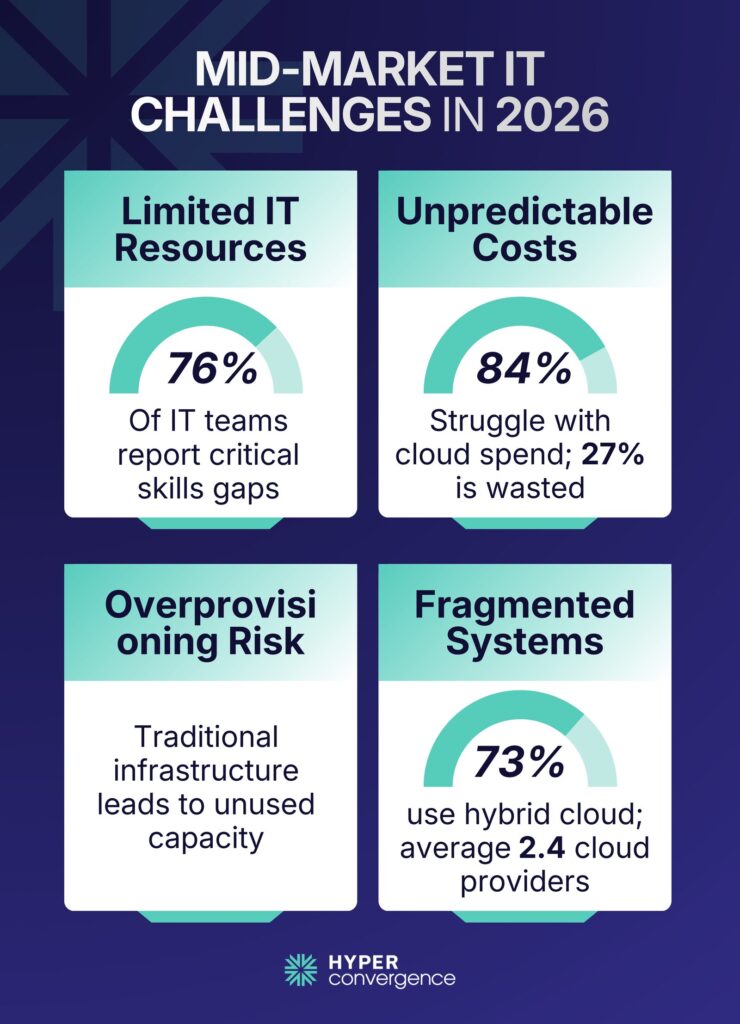
Many teams run lean, and skills gaps make complex infrastructure harder to manage. Around 76% of IT decision-makers face critical skills gaps in their departments. This problem becomes more visible in environments still running traditional data center architecture, where managing separate storage arrays, networking tools, and compute layers requires deeper specialization.
Rising and Unpredictable Costs
Costs are harder to control when licensing and cloud spend keep changing. Flexera found that 84% of organizations cite managing cloud spend as a top challenge, and 27% of cloud spend remains wasted. For many companies, the issue goes beyond cloud billing and into overall cost management across the entire data center infrastructure.
Scaling Without Overbuilding
Traditional infrastructure often forces companies to buy more capacity than they need right away, leading to waste and slowing purchasing decisions. Older models built around converged infrastructure often require large upfront investments, even when workloads and resource allocation needs gradually grow.
Fragmented Infrastructure
Separate tools and mixed environments add more management overhead. Flexera 2026 State of the Cloud Report shows that 73% of organizations use hybrid cloud this year, and the average organization uses 2.4 public cloud providers. Managing compute, storage resources, network resources, and virtualization resources across different platforms makes daily operations harder and reduces overall operational efficiency.
How HCI Helps Mid-Market IT Teams
Hyperconverged infrastructure HCI solves these problems by simplifying infrastructure into a single platform.
Unified Infrastructure
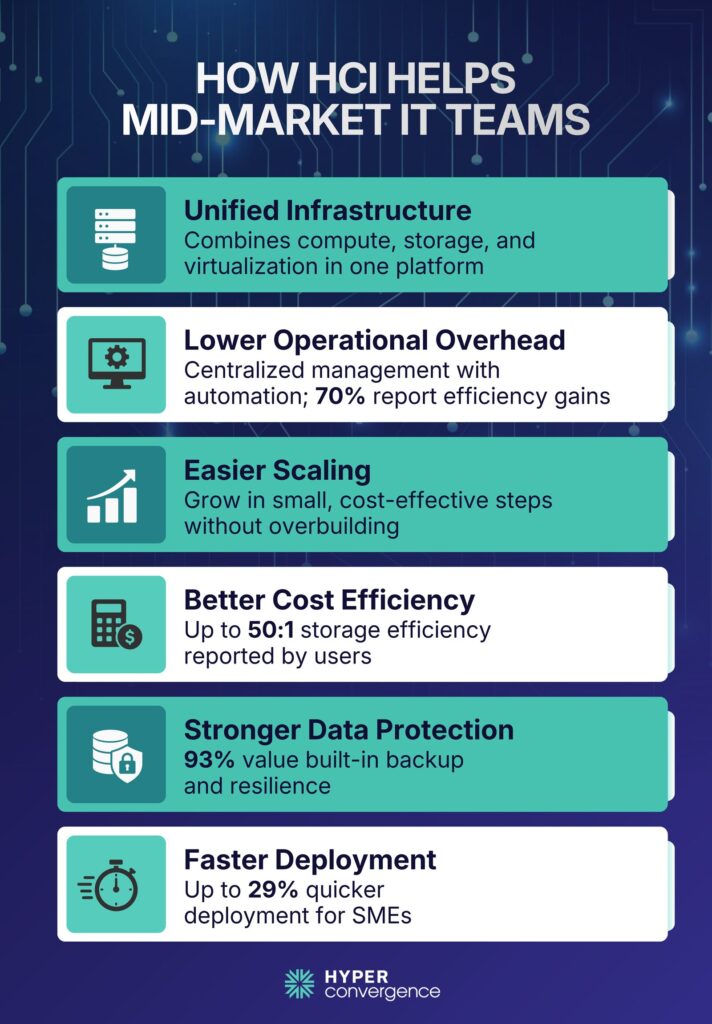
Compute, storage, and virtualization are integrated into one single software stack. Instead of relying on external components such as software defined storage solution layers, hyperconverged infrastructure combines everything into a unified system. This reduces hardware footprint and simplifies deployment while making it easier to manage virtual machines and applications.
Lower Operational Overhead
- Centralized management
- Automated updates and lifecycle management
- Reduced dependency on specialized skills
Such simplified management allows smaller teams to operate modern infrastructure without deep expertise in multiple virtualization technologies. It also helps streamline data center operations and improve day-to-day reliability.
This is why 70% of enterprises report efficiency gains after adopting HCI.
Easier Scaling
Hyperconverged infrastructure lets companies grow in smaller, more manageable steps instead of overbuilding upfront. Instead of expanding entire infrastructure layers, teams can scale nodes and balance storage resources, compute, and networking capacity based on real workload demand.
Better Cost Efficiency
Hyperconverged infrastructure can reduce wasted storage and hardware overhead. Many platforms rely on software defined storage to pool disks across nodes and optimize capacity usage.
In an HPE SimpliVity user survey, 67% of respondents said they achieved 50:1 or more storage efficiency. (source)
Stronger Data Protection
Built-in resilience is another advantage. Integrated disaster recovery capabilities and replication features help organizations maintain stronger business continuity without deploying separate DR infrastructure. In the same HPE SimpliVity survey, 93% of users rated integrated data protection as valuable or extremely valuable.
Faster Deployment
As quick adopters of cost-efficient HCI platforms, small and medium enterprises reported up to 29% faster deployment timelines.
Quick Comparison: Best Mid-Market HCI Solutions for 2026
A quick comparison table helps buyers narrow the shortlist, but real costs depend on workload size, licensing model, and hardware configuration. Request a customised HCI quote to see how different platforms price out for your specific environment.
| HCI Platform | Best for | Pricing Model | Ease of Use | Key Strength |
| Nutanix | Overall Value | Subscription tiers | High | All-in-one platform |
| Scale Computing | Simplicity | Per-core software/ bundle pricing | Very High | Minimal IT effort |
| VMware vSAN | VMware environments | Bundles subscription | Medium | Ecosystem depth |
| StarWind HCI | Budget Buyers | Flexible | High | Low-cost entry |
| HPE SimpliVity | HPE-centered edge & VDI | Quote-based appliance | Medium | Integrated data protection |
5 Best HCI Solutions for Mid-Market Companies in 2026
Here are the top 5 hyperconverged infrastructure selections for mid-market buyers:
1. Nutanix — Best Overall HCI Platform
Overview
Nutanix is the strongest all-around pick for most mid-market buyers because it gives you a full HCI stack in one place. Nutanix Cloud Infrastructure includes AHV, Prism, Disaster Recovery, Lifecycle Manager, and 1 TiB of Nutanix Unified Storage for files and objects through its integrated file service ability.
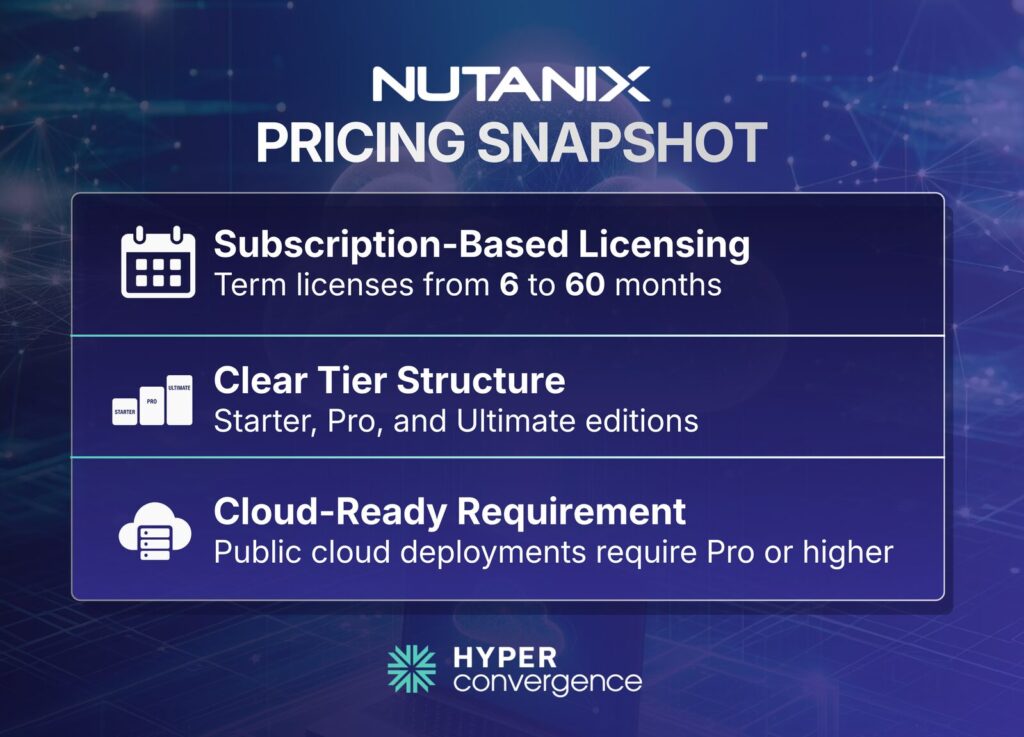
Nutanix also makes its product structure relatively easy to understand with Starter, Pro, and Ultimate editions, offering a single solution within a unified software defined setup.
Key Strengths
- AHV comes with the platform, so buyers do not need a separate hypervisor purchase
- The platform supports multiple leading hypervisors, which gives organizations flexibility as their infrastructure evolves
- Starter includes core HCI functions, and Nutanix says the maximum cluster size is 12 nodes, which maps well to many mid-market environments
- Prism and Lifecycle Manager make daily administration easier for smaller teams with their simplified management through a single interface
- Nutanix has a strong current review base, with 4.5/5 from 316 G2 reviews (source)
Limitations
- Nutanix can feel expensive for buyers with tight budgets, and current G2 reviews still mention cost as a drawback
- Starter is capped at 12 nodes, so larger deployments may move to Pro sooner than expected
- Teams deeply tied to VMware may still need a migration plan and staff training if they move to AHV
Pricing and Licensing
Nutanix’s public pricing structure is clear. All NCI SKUs are term licenses and can be configured from 6 to 60 months. Nutanix also notes that public cloud deployment requires at least the Pro edition.
Best for
Nutanix is best for mid-market companies that want one platform for virtualization, storage, DR, and daily management, especially if they want a cleaner path beyond a VMware-only future. This full stack HCI platform enables organizations to support evolving business needs, improve infrastructure agility, and run business critical applications across hybrid environments.
2. Scale Computing — Best for Simplicity
Overview
Scale Computing is one of the best fits for mid-market buyers with small IT teams. Its core pitch is simple: easier virtualization and HCI without a heavy management burden. That is a strong match for companies that want stable infrastructure without a lot of overhead or complex service layers.
Key Strengths
- It has a 4.7/5 rating from 259 reviews, and 185 of those reviews come from mid-market companies
- Current users repeatedly praise ease of use, support, and fast setup
- Scale offers visible entry pricing, with the Standard license listed at $189 per core per year on a 5-year term
- The platform is built around simplicity, high availability, and automated provisioning through an intuitive management interface
Limitations
- Scale does not have the same broad ecosystem presence as Nutanix or VMware
- Some users note that adding compute resources can mean adding full nodes rather than making smaller incremental changes
- Buyers with very specialized enterprise needs may want a larger platform ecosystem
Pricing and Licensing
Scale stands out because buyers can see an actual starting point before they talk to sales. It has 4 pricing editions:
- Standard at $189,
- Professional at $238.97 per core per year,
- Essentials packages starting at $3,485
- Professional Essentials starts at $4,400
That kind of visibility is useful for mid-market planning.
Best for
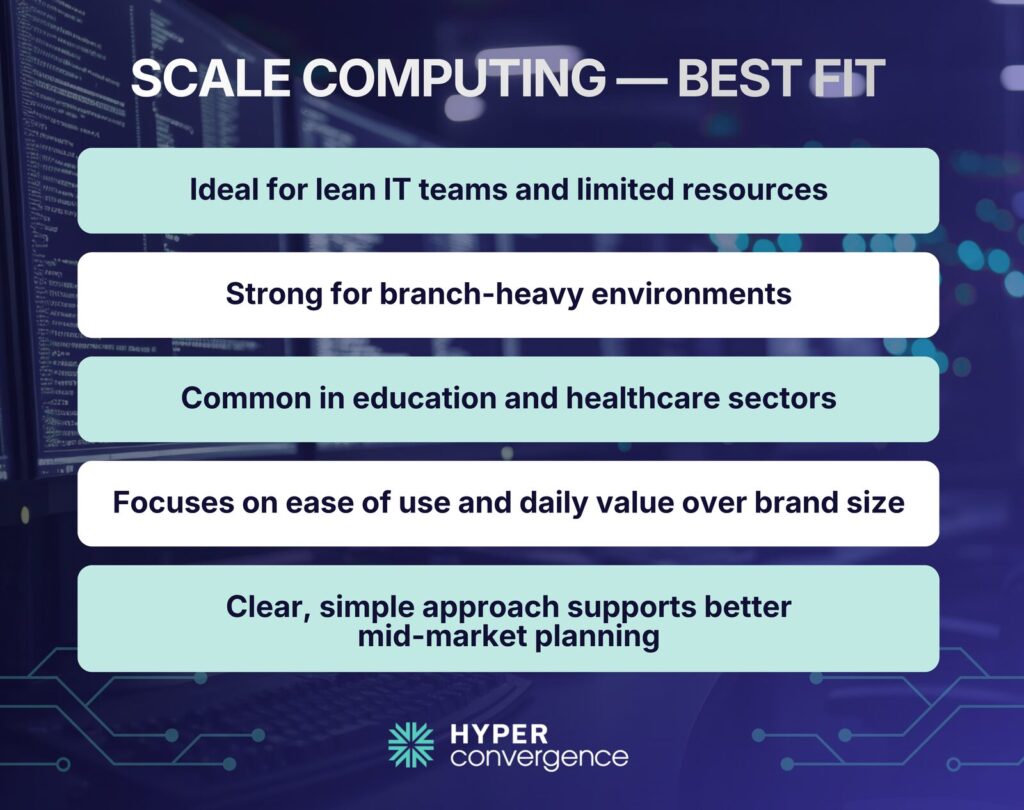
Scale is best for lean IT teams, branch-heavy businesses, schools, healthcare groups, and buyers who care more about ease of use and day-to-day value than about owning the biggest brand in the category.
3. VMware vSAN — Best for VMware Environments
Overview
VMware vSAN still belongs on a mid-market shortlist if the company already runs VMware and wants the least disruptive path forward. The main difference now is that vSAN is no longer best viewed as a stand-alone product.
Broadcom says that as of June 17, 2025, vSAN is part of VVF 9.0 and VCF 9.0, which changes how buyers need to think about licensing and renewals for both cloud and on premises infrastructure.
Key Strengths
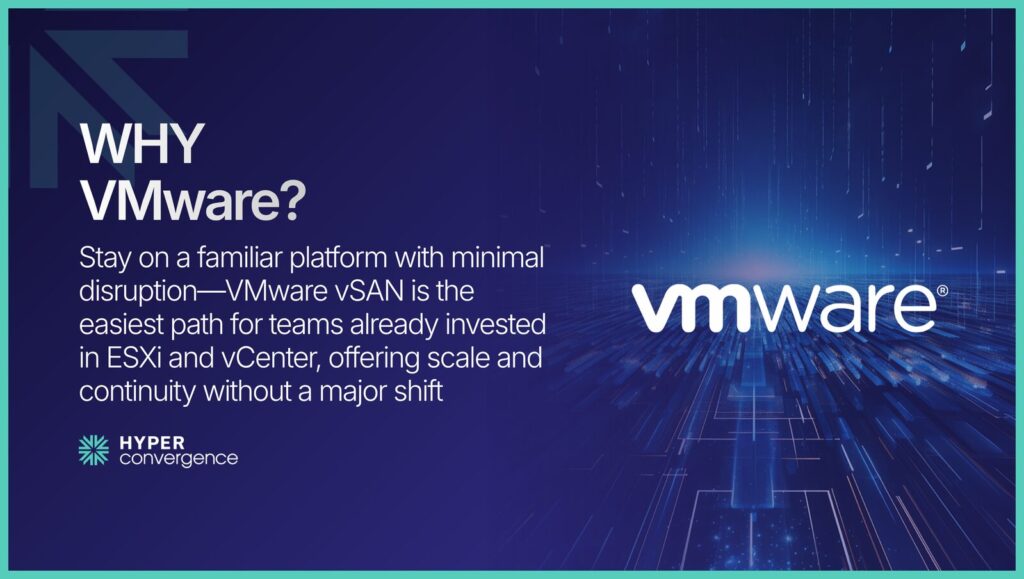
- It is the most natural fit for teams already invested in ESXi and vCenter
- Broadcom says vSAN clusters can scale up to 64 hosts, which gives VMware a strong option for larger environments
- At the time of writing this article, it has a 4.4/5 rating from 191 reviews, with repeated comments about easier storage management inside existing VMware environments
- It is still the lowest-change option for companies that want to stay on VMware rather than switch platforms
Limitations
- Broadcom’s version 9.0 licensing is strictly subscription-based, and the old 25-character key workflow is gone
- Broadcom ended general support for vSphere 7.x and vSAN 7.x on October 2, 2025, so some buyers are already under time pressure
- If we compare Nutanix vs VMware vSAN, the latter offers less flexibility for companies that want to reduce their dependence on VMware over time
Pricing and Licensing
- Sold through bundled subscriptions (VCF/VVF), not as a single storage line item
- Cost depends on full stack, not just HCI software
Best for
VMware vSAN is best for current VMware shops that want continuity, already have strong vCenter and ESXi skills, and do not want a major platform shift right now.
4. StarWind HCI — Best for Cost Efficiency
Overview
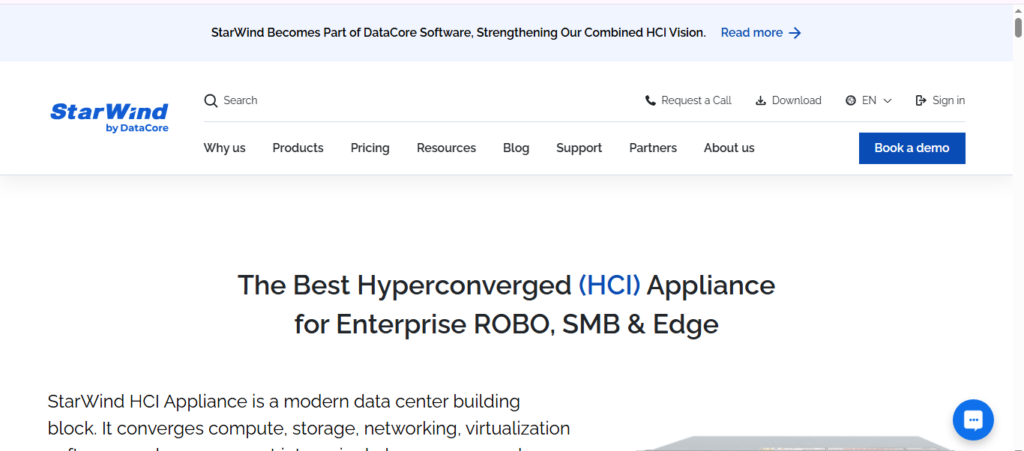
StarWind is the strongest value-driven pick in this list. It is especially attractive to mid-market teams that want high availability and shared storage without buying separate storage arrays or a dedicated SAN layer.
StarWind’s HCI Appliance is delivered as a pre configured system that can start from as small as 2 nodes and does not require a witness, which is a practical fit for smaller data center deployments and remote sites. Many teams adopt StarWind Virtual SAN because it can convert local disks into resilient shared storage across virtual machines without introducing complex infrastructure.
Key Strengths
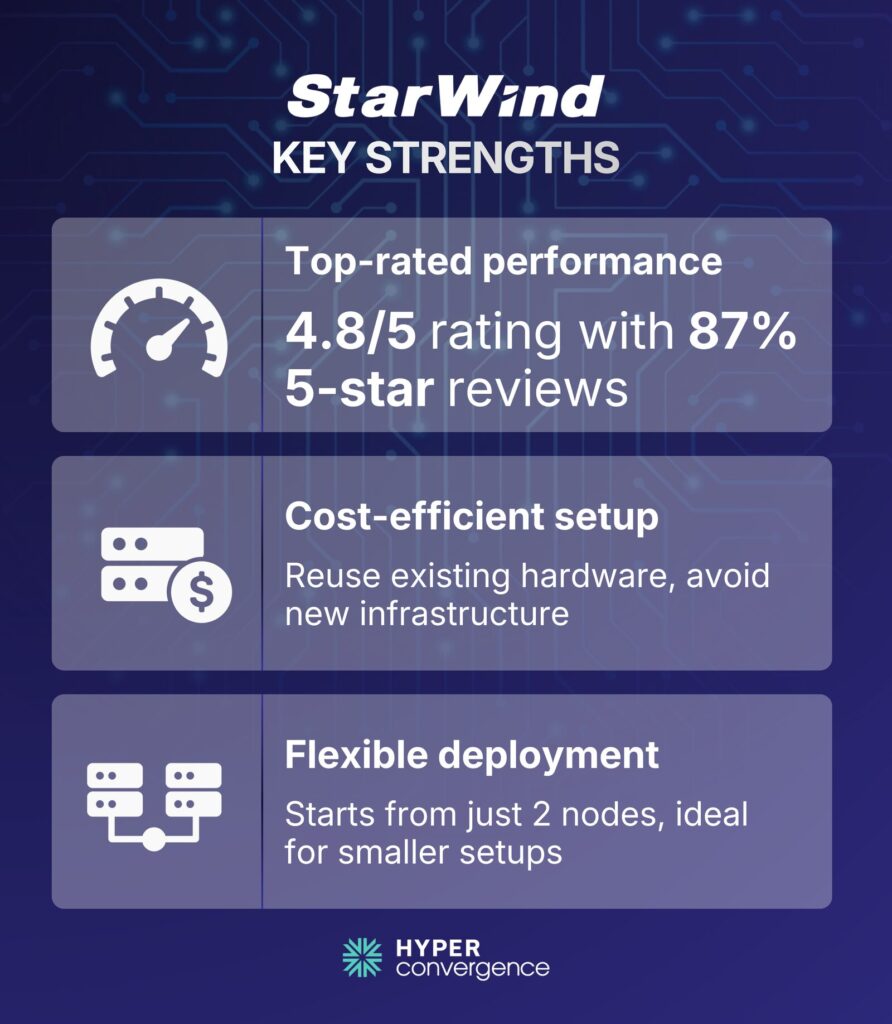
- G2 shows it has a 4.8/5 rating from reviewers with a 87% of 5-star reviews, which is one of the strongest review scores in this group
- StarWind’s HCI approach works well for buyers who want to reuse existing hardware and commodity hardware instead of buying a full new stack
- The 2-node starting point is useful for smaller clusters and remote offices running enterprise applications
- Built-in synchronous mirroring ensures high availability while maintaining performance for high performance applications
- Current reviews repeatedly mention cost savings, simpler HA, and avoiding separate SAN hardware
Limitations
- StarWind has lower mainstream visibility than Nutanix or VMware among companies, compared to the best HCI solutions
- Some users still mention setup and documentation as weaker spots, especially for first-time deployments
- Buyers who want a very large ecosystem or a major enterprise brand may prefer other options
Pricing and Licensing
StarWind doesn’t offer a public list price. Yet its biggest pricing advantage is the ability to avoid buying separate SAN hardware and to use independent storage resources you already own within the existing environments.
That is why it is such a strong fit for cost-sensitive mid-market companies that want reliable compute scaling without major infrastructure redesign.
Best for
Among other HCI solutions, StarWind is best for budget-sensitive mid-market companies, smaller clusters, remote sites, and teams that want HA without paying for a heavy enterprise stack. It works particularly well in HCI environments where companies want resilient shared storage while still keeping control over their underlying infrastructure.
5. HPE SimpliVity — Best for Built-in Backup and HPE Environments
Overview
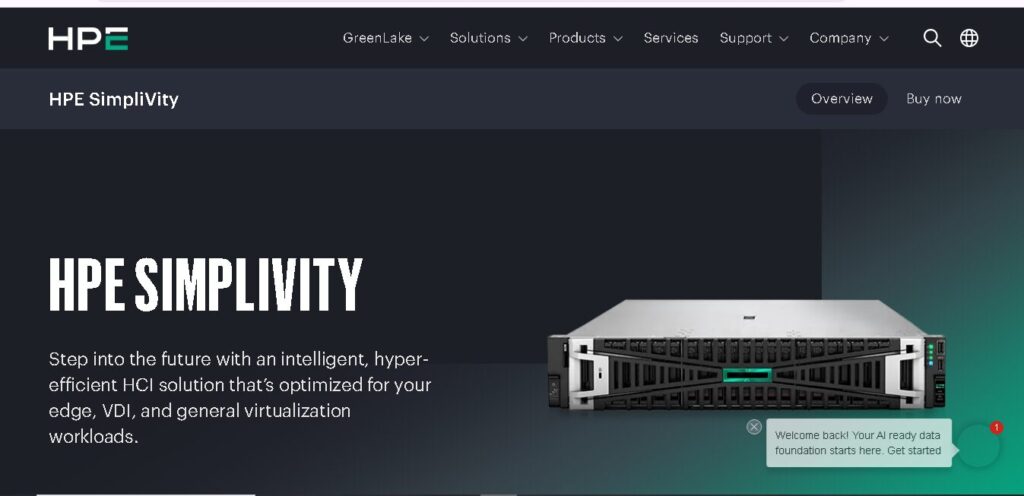
HPE SimpliVity is a sensible fifth choice for strictly mid-market buyers because it still lines up well with edge computing, VDI, and general virtualization workloads, especially for HPE-centered environments.
HPE says SimpliVity offers built-in data protection and high availability across just 2 nodes, which can be attractive to smaller deployments that still need resilience.
Key Strengths
- HPE positions SimpliVity for edge, VDI, and general virtualization workloads, which are common mid-market use cases
- HPE says it provides high availability across 2 nodes with built-in data protection and integrated security
- A Gartner study shows 4.4/5 from 305 ratings, which indicates steady user satisfaction, even if it is not the loudest product in the category right now
- The platform supports load balancing across nodes to maintain consistent performance for business workloads
Limitations
- Higher cost compared to software-only HCI solutions
- Tied to HPE hardware, limiting flexibility
- Depends on VMware, adding licensing cost
- Reviews still mention installation complexity, so it may not be the easiest product for very small teams
Pricing and Licensing
HPE SimpliVity is more of a quote-led buy than a visibly priced one. That means:
- Pricing varies based on node size and configuration
- Includes additional costs for VMware and support
- Less predictable upfront compared to subscription-based platforms
It can work well for buyers already comfortable with HPE, but it is less helpful for companies that want simple public pricing early in the process.
Best for
HPE SimpliVity is best for HPE-centered mid-market buyers who want strong data protection, smaller, highly available deployments, and a good fit for edge or VDI projects.
How We Picked These Best HCI Solutions
These top five HCI platforms were chosen with a strict mid-market lens. The scoring focused on several key factors, including-
- pricing clarity
- licensing friction,
- value for money
- ease of deployment
- ease of daily management
- support fit for smaller IT teams
- whether the product makes sense for organizations seeking a smaller setup, and may not have enterprise-level staffing or budget
That is why Scale Computing and StarWind made the list, and why VxRail did not.
We also reflected on current market conditions, not older traditional HCI buying habits. VMware had to be judged in its Broadcom-era form, Nutanix had to be judged as a full platform with AHV included, and HPE SimpliVity had to be judged against actual mid-market use rather than enterprise mindshare.
Modern HCI platforms are also evolving to support technologies like artificial intelligence, hybrid infrastructure models, and scalable compute frameworks.
So, we picked
- Nutanix- as a full platform with AHV included
- Scale Computing- as a simplicity-first choice
- StarWind- as the strongest value option
- VMware vSAN- in its current VVF and VCF form
- HPE SimpliVity- as a focused HPE-centered alternative.
How to Choose the Right HCI Solution for Medium Businesses
There are a few things you need to keep in mind when choosing the right HCI for your medium IT landscape, especially when modern infrastructure must support your growing business needs.
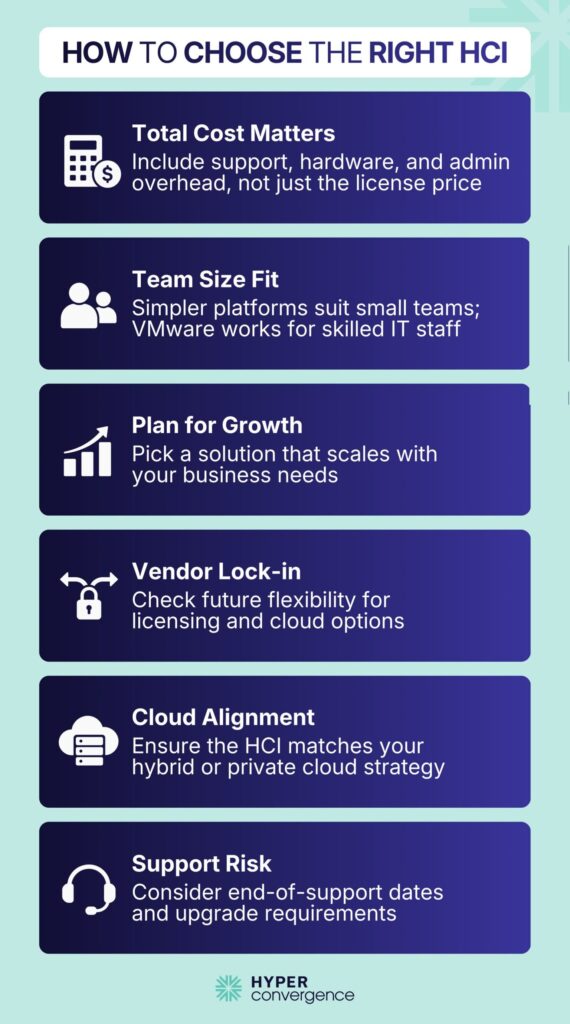
1. Focus on Total Cost, Not Just Price
Look past the software quote. Compare support, hardware, backup, migration work, and admin time. Nutanix licenses run from 6 to 60 months, while VMware now uses subscription-led licensing through VVF 9.0 and VCF 9.0. Those differences can change the real cost over time, even when the starting quote looks similar. The real cost picture should also include how efficiently the platform uses compute resources and infrastructure capacity.
2. Match Platform Complexity to Team Size
Leaner teams usually do better with simpler platforms like Nutanix or Scale. These platforms are easier to manage day to day and usually place less pressure on a small IT staff. Many of them provide centralized control through a single interface, which improves operational efficiency significantly.
For example, VMware vSAN is often a better fit when the team already has VMware skills and wants to stay in that environment.
3. Plan for Growth Before Buying
Choose a platform that can scale without forcing a redesign. Nutanix Starter supports up to 12 nodes, VMware vSAN can scale to 64 hosts, and StarWind can start from 2 nodes. That gives mid-market buyers very different capacity planning options depending on budget, workload growth, and uptime needs. Scaling flexibility also matters for teams running large numbers of virtual machines or expanding workloads in remote offices.
4. Evaluate Vendor Lock-in Early
Some platforms give you more flexibility later than others. Nutanix includes AHV and supports broader deployment options, while VMware keeps you more tightly tied to its own stack and bundle model. This matters if you want more choice in licensing, cloud direction, or future platform changes. Platforms that separate virtualization resources from hardware dependencies can offer more long-term flexibility.
5. Align Platform with Cloud Strategy
Choose a platform that matches where your infrastructure is going. For hybrid cloud, Nutanix has a clearer public story, and NC2 is generally available on Google Cloud in 17 regions. VMware is often the better fit when the company wants a VMware-led private cloud path instead of broader platform flexibility.
Hybrid strategies often combine on premises infrastructure with public cloud deployments, which enables organizations to scale resources more easily.
6. Check Support and Renewal Risk
Do not treat lifecycle dates as a minor detail. Broadcom ended support for vSphere 7.x and vSAN 7.x on October 2, 2025, so older VMware environments now carry more renewal and upgrade pressure. If your current setup depends on those versions, supportability should be part of the buying decision from the start. This is especially important for organizations running critical workloads in the data center, where downtime can affect core operations.
Final Recommendation: Which is Your Best Pick?
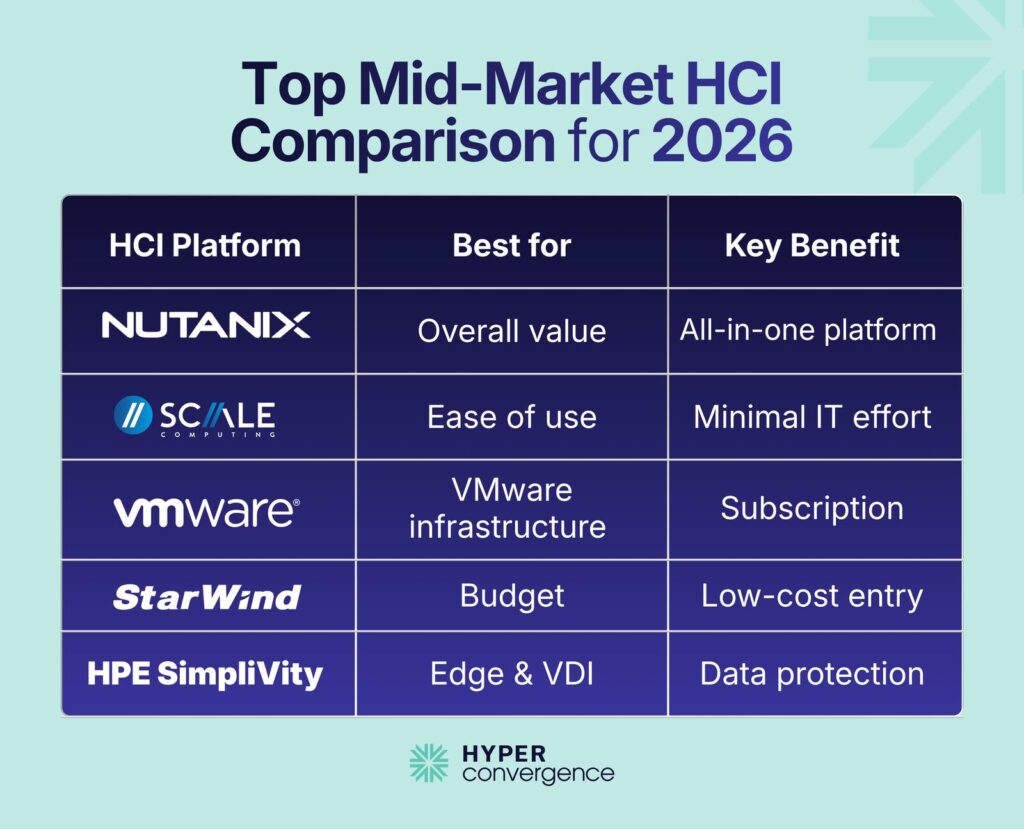
Best Overall: Nutanix — Best for mid-market companies that want the strongest mix of usability, platform depth, and long-term flexibility.
Best for Simplicity: Scale Computing — Best for lean IT teams that want an easy-to-run platform with less daily management overhead.
Best for VMware Users: VMware vSAN — Best for companies already invested in VMware that want the least disruptive path forward.
Best Budget Pick: StarWind — Best for cost-conscious buyers looking for high availability without paying for a heavier enterprise stack, allowing users to reuse existing infrastructure.
Best for HPE-centered Edge and VDI: HPE SimpliVity — Best for HPE-focused environments that need compact, highly available infrastructure with strong built-in data protection.
Conclusion
There is no single best HCI platform for every mid-market company. The right choice depends on your budget, team size, and long-term IT strategy.
Nutanix offers a strong balance across cost, flexibility, and usability. VMware vSAN remains a solid option for existing VMware environments.
However, the remaining 3 also deserve serious consideration because each one solves a different mid-market need well, whether that is simplicity, cost efficiency, or HPE-centered deployment.
The best buying decision comes from matching the platform to your actual operating model rather than choosing the biggest name or the longest feature list.
Before making a final decision, ask each vendor for a workload-based quote that includes software, support, backup or disaster recovery needs, implementation effort, and migration costs. That is the fastest way to see which platform actually makes the most business sense for your team.
FAQs
HCI combines compute, storage, and virtualization into one software platform, simplifying management, reducing hardware needs, and enabling mid-market teams to scale infrastructure easily with fewer resources.
Nutanix, Scale Computing, VMware vSAN, StarWind, and HPE SimpliVity are the best HCI solutions based on usability, pricing flexibility, scalability, and mid-market fit.
Scale Computing, due to its simple interface, automation, and minimal need for specialized IT skills.
Costs vary by platform, ranging from per-core subscriptions and bundled pricing to quote-based models depending on hardware, licensing, and deployment size.
StarWind, because it allows use of existing hardware and avoids separate SAN purchases, lowering overall infrastructure costs.
Nutanix includes its own hypervisor and offers flexibility, while VMware vSAN suits existing VMware environments and follows bundled subscription licensing.
VMware vSAN supports up to 64 hosts, while Nutanix offers flexible node-based scaling suited for gradual growth.
HPE SimpliVity, with strong built-in backup, replication, and integrated data protection features.
Mid market companies with smaller infrastructure should consider total cost, ease of use, scalability, vendor lock-in, cloud strategy, and support requirements.
VMware vSAN, as it integrates directly with existing VMware tools like vCenter and ESXi for minimal disruption.