Nutanix vs VMware vSAN: Which HCI Platform Is Right for You?
Nutanix and VMware vSAN remain two of the leading HCI solutions in 2026, but the landscape shifted after Broadcom acquired VMware in 2023. VMware’s move to a subscription-only model pushed teams to reassess cost and flexibility.
Nutanix now appeals to mid-market buyers seeking simplicity and is often considered one of the best HCI solutions for mid-market companies, while VMware fits existing ecosystem users. Current user ratings also reflect this: 4.6/5 for Nutanix vs 4.5/5 for vSAN.
With vSphere 7.x and vSAN 7.x support ending in 2025, this is no longer just a storage comparison, but a critical platform decision that affects licensing, support, upgrades, cloud strategy, and migration risk for the next several years.
This guide is built for IT buyers, infrastructure leaders, and procurement teams who want a clear, practical view of Nutanix vs VMware vSAN before choosing their next HCI platform.
Nutanix vs VMware vSAN: Quick Comparison
The table below reflects current Nutanix and Broadcom product documentation for 2025 and 2026:
| Feature | Nutanix Cloud Infrastructure | VMware vSAN |
| Core Architecture | Full HCI stack in one platform | Modular stack within the VMware ecosystem |
| Hypervisor | AHV included, supports ESXi & Hyper-V | ESXi only (required) |
| Key Management | Single interface with Prism | Multiple tools (vCenter + Cloud Foundation) |
| Licensing | Flexible subscription tiers | Bundled in VVF and VCF |
| Editions | Starter, Pro, Ultimate | Included in VVF 9 and VCF 9 |
| Scalability | Starts small, scales beyond 12+ nodes | Up to 64 hosts per cluster |
| Cloud Strategy | Hybrid and multicloud (AWS, Azure, Google Cloud) | Private cloud focused on broader infra support |
| Migration Options | Nutanix Move with multi-hypervisor flexibility | Best suited for existing VMware environments |
| Best Fit | Mid-market, cost-conscious buyers | Enterprises with heavy VMware investment |
Beyond these features, the two HCI setups offer different pricing based on your exact infrastructural needs. So, it’s better to get a custom HCI quote for personalized recommendations between these two.
What Actually Changed After Broadcom
Broadcom’s acquisition of VMware in 2023 changed how VMware products are packaged, licensed, and supported. It means the following:
- VMware vSAN is no longer commonly sold as a standalone product
- It now sits inside VMware vSphere Foundation 9.0 and VMware Cloud Foundation 9.0 bundles
- Licensing moved to subscription-based models managed through VCF Operations
- Some features like vVols are being phased out, with discontinuation planned in VCF/VVF 9.3.0
- Support is now handled under Broadcom Software Maintenance, sometimes involving partner routing
What This Means for Buyers:
You are no longer choosing only a storage solution. You are choosing between two platform strategies:
- Nutanix → one integrated HCI platform with built-in flexibility
- VMware → a broader private cloud ecosystem with tighter vendor alignment
Nutanix Overview
Nutanix Cloud Infrastructure, or NCI, is a full hyperconverged infrastructure platform that combines compute, storage, virtualization, disaster recovery, lifecycle tools, and management in one offering. Nutanix says NCI includes AOS, Nutanix software, AHV, Disaster Recovery, Prism, Insights, Lifecycle Manager, and 1 TiB of Nutanix Unified Storage for files and objects. As a software defined storage solution, Nutanix sells NCI in Starter, Pro, and Ultimate editions.
What Nutanix Does Well
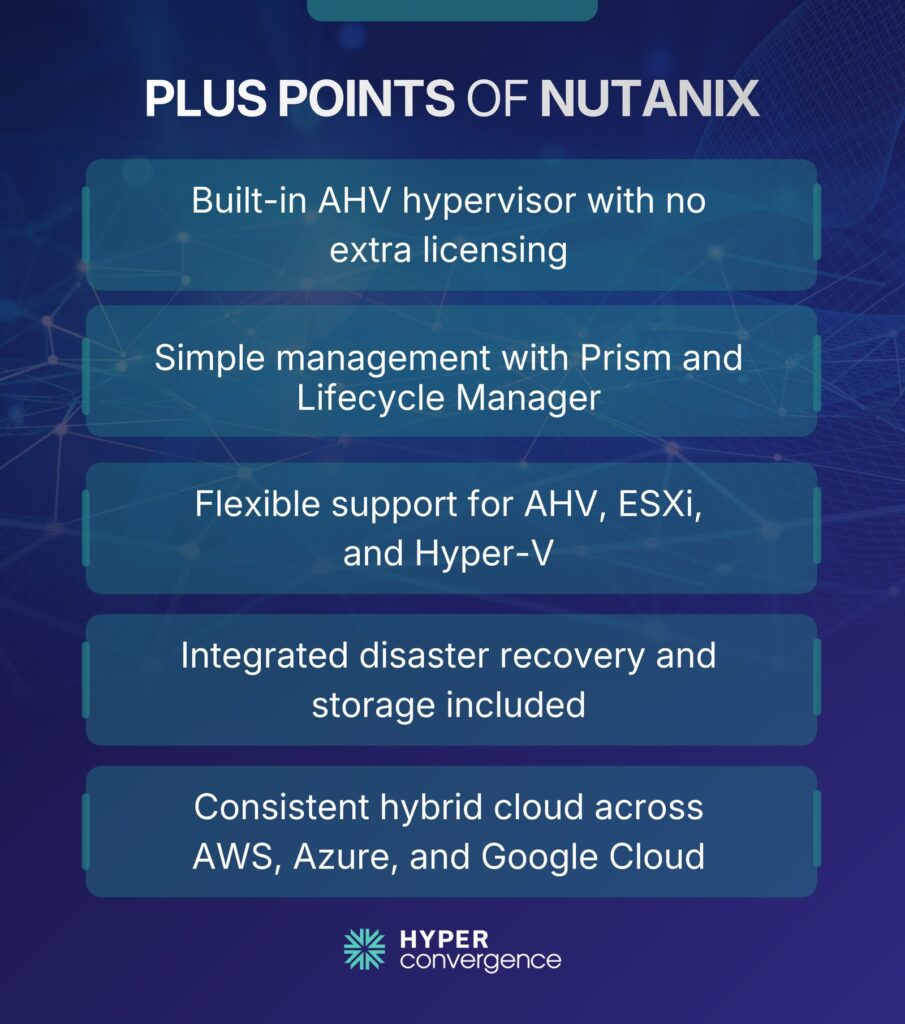
- AHV comes with the platform, so buyers are not forced into a separate hypervisor purchase, unlike setups built around a VMware hypervisor.
- Prism and Lifecycle Manager provide unified management, keeping most daily administration, upgrades, and visibility in one place.
- Nutanix gives buyers more choice by supporting AHV, ESXi, and Hyper-V, including Nutanix AHV and Microsoft Hyper-V.
- Nutanix includes built-in DR and 1 TiB of file and object storage capacity in NCI, which can reduce the need for extra add-ons early in a project.
- NC2 extends the same operating model into AWS, Azure, and Google Cloud, which makes hybrid cloud environments easier to plan and explain to business stakeholders.
Where Nutanix Falls Short
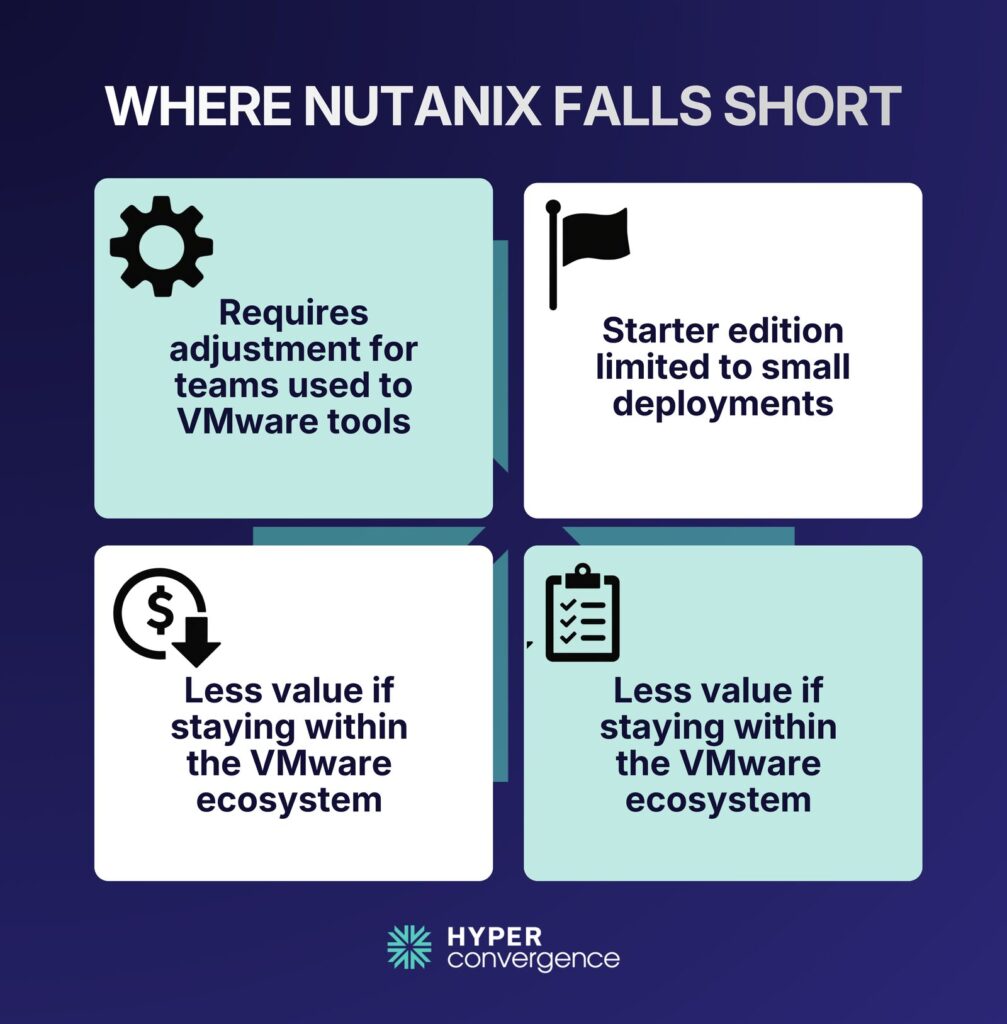
- Nutanix can still feel like a platform change for teams that have spent years standardizing on VMware tools and habits across HCI environments.
- Starter is capped at 12 nodes, so larger environments often move to Pro faster than they first expect.
- Buyers who only want to preserve an existing VMware operating model may see less value in switching to Nutanix, especially when comparing both VMware and Nutanix stacks.
- Some organizations will still need retraining and migration planning if they want to move core workloads from ESXi to AHV, particularly those coming from VMware ESXi environments.
Pricing Model
Nutanix uses a subscription-based model with multiple tiers, often improving cost efficiency for buyers. The main buyer advantage is that the hypervisor is included, and Nutanix publicly lays out what sits inside Starter, Pro, and Ultimate. Nutanix also says NCI term licenses can run from 6 to 60 months and are portable across approved platforms and public clouds, which makes early planning easier than in many bundle-driven models and supports long-term cost savings.
Best Use Cases
- Mid-market refresh projects where the team wants fewer moving parts and less hardware sprawl.
- VMware diversification projects where the business wants a future option beyond ESXi.
- Hybrid and multicloud environments where workload mobility matters across edge environments.
- Lean IT teams that want simpler day-to-day administration with built-in role-based access control.
VMware vSAN Overview
VMware vSAN is still a major HCI product, but the buying model is different now. Broadcom’s current documentation shows that vSAN sits inside VMware vSphere Foundation 9.0 and VMware Cloud Foundation 9.0, released on June 17, 2025. (source)
In practice, that means most buyers are no longer comparing Nutanix with a stand-alone software defined storage product. They are comparing Nutanix with a broader VMware platform path.
What VMware vSAN Does Well
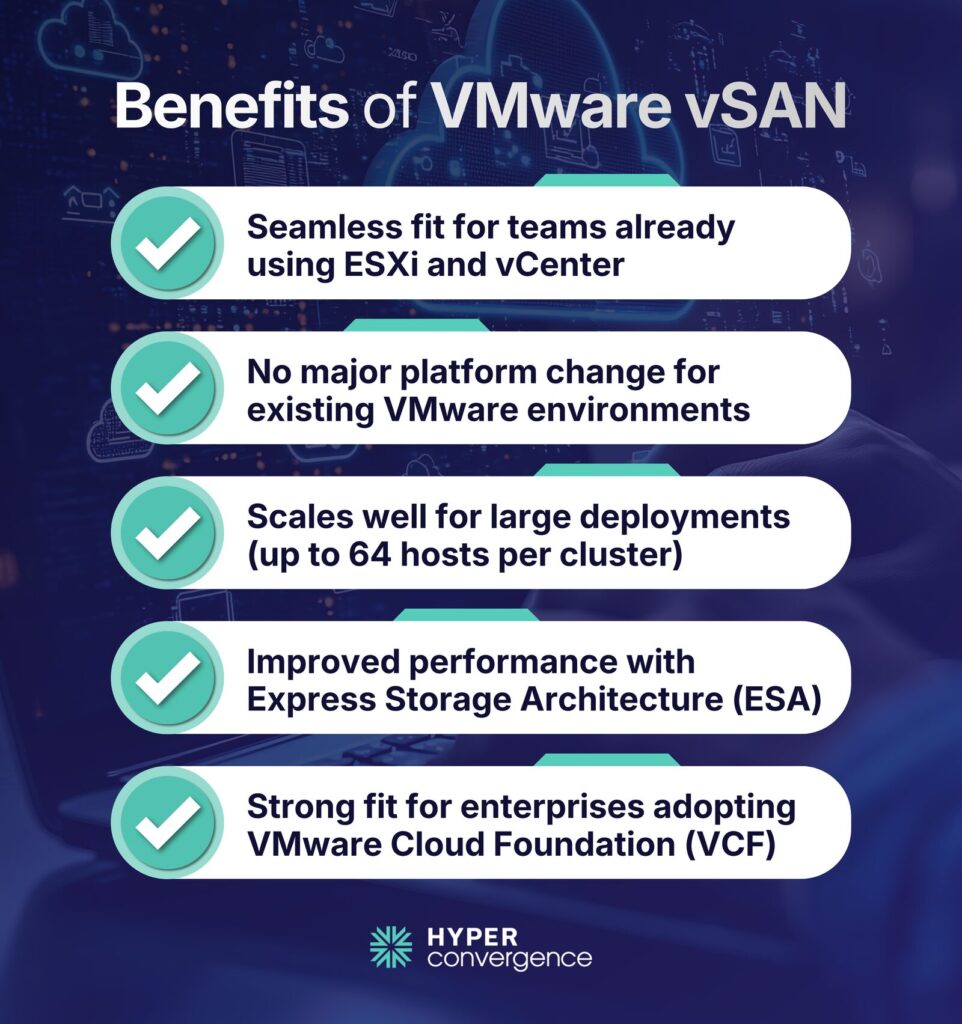
- VMware vSAN fits naturally for teams that already run ESXi and vCenter at scale within a VMware cluster.
- The VMware path avoids a major platform change for organizations that want continuity more than flexibility.
- vSAN can scale to 64 hosts per cluster, which gives VMware a strong answer for demanding workloads.
- VMware’s newer Express Storage Architecture improves the technical picture on the VMware side, especially for diverse workloads. Broadcom says snapshot deletions in vSAN ESA were more than 100x faster than older vSAN snapshot methods.
- Broadcom keeps positioning VCF as a unified private cloud platform, which can work well for enterprises already committed to that operating model and integrated tools like nutanix flow alternatives.
Where VMware vSAN Falls Short
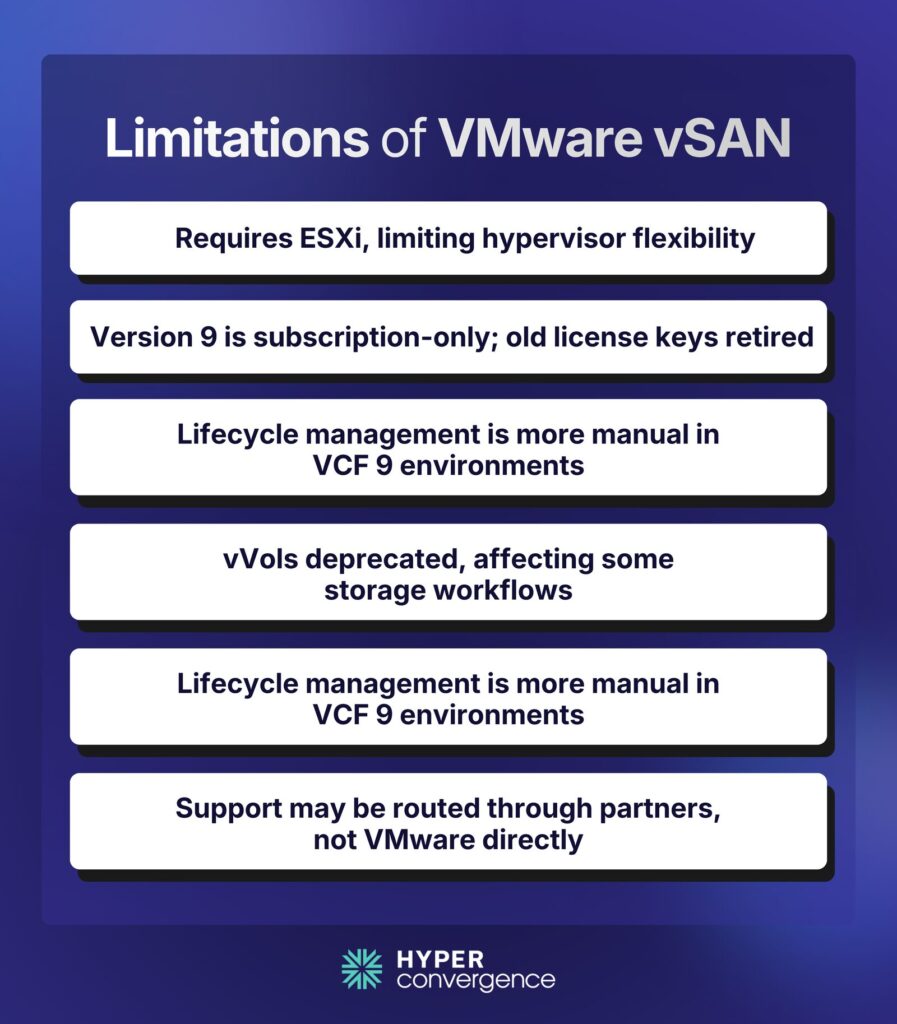
- VMware vSAN requires ESXi, so buyers get less flexibility across multiple hypervisors than they do with Nutanix.
- Version 9 licensing is now strictly subscription-based, and Broadcom says the old 25-character license key method has been retired.
- In VVF 9 environments, Broadcom says integrated fleet lifecycle management is restricted, so ESX and vCenter patches must be applied per component instead of through the fuller VCF workflow.
- Broadcom has deprecated vVols beginning with VCF 9.0 and VVF 9.0, with full discontinuation planned for VCF/VVF 9.3.0. That matters for buyers with storage designs tied closely to vVol-based workflows.
- Broadcom says some support requests can be routed to authorized partners, so buyers should ask direct questions about who will actually handle first-line and escalation support.
Pricing Model
VMware now primarily sells vSAN as part of VMware vSphere Foundation or VMware Cloud Foundation. That means many buyers are no longer pricing only a storage layer. They are pricing a broader VMware platform bundle. This can work well for teams that want the full VMware path, but it often makes the buying process more complex for organizations that only want straightforward HCI.
Best Use Cases
- Large VMware estates that already depend on ESXi and vCenter.
- Enterprises that want to stay on a VMware-first operating model.
- Teams that value continuity more than hypervisor flexibility.
- Large-cluster environments that require VMware stack storage often use features like erasure coding and integrated data protection.
Nutanix vs VMware vSAN: Key Differences That Matter
1. Architecture and Platform Design
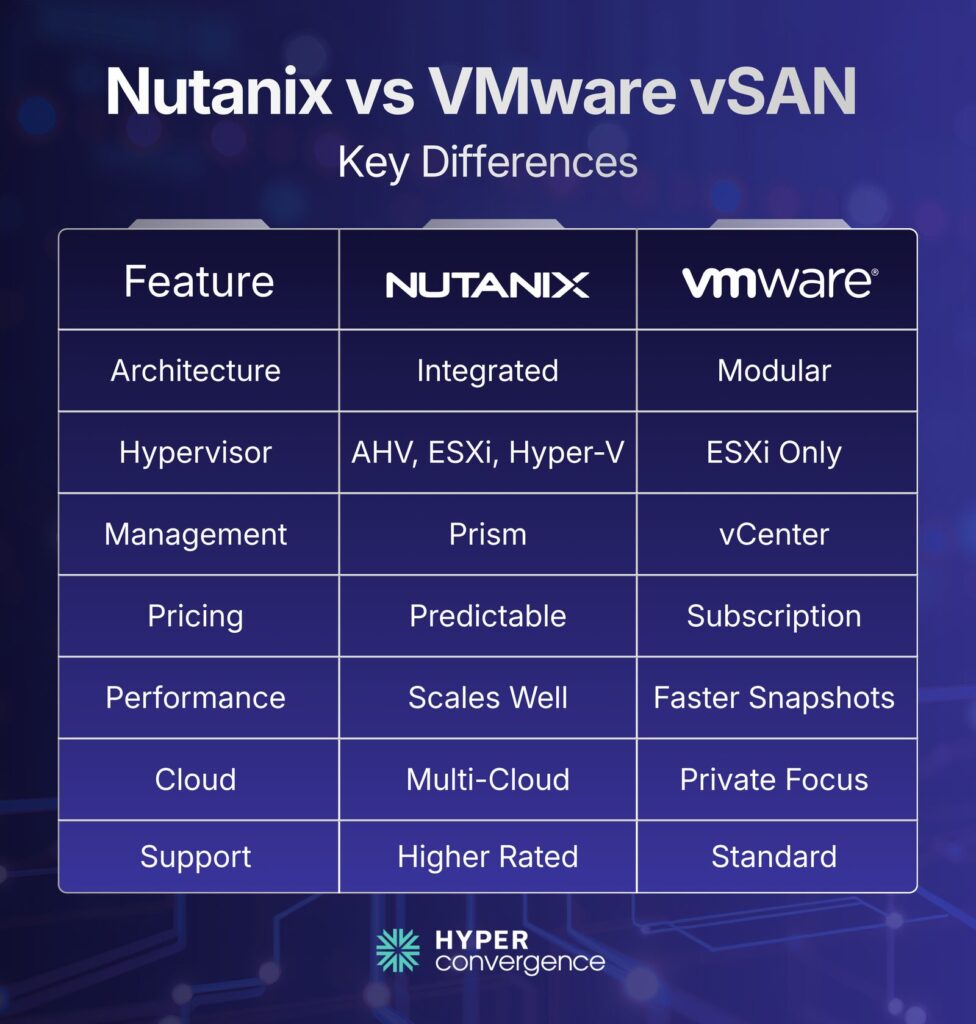
Nutanix delivers a fully integrated stack with the core services already packaged together. On the other hand, VMware uses a broader platform approach where vSAN lives alongside ESX, vCenter, and, depending on the bundle, other Cloud Foundation services. In plain terms, Nutanix usually feels more self-contained, while VMware often feels like part of a larger private cloud framework with HCI architecture.
What It Means: Nutanix is often easier to evaluate and deploy as one hyperconverged solution. VMware can offer more depth inside the VMware world, but it usually brings more surrounding components and more planning decisions.
2. Hypervisor and Vendor Lock-In
Nutanix includes the AHV hypervisor and also supports ESXi and Hyper-V. VMware vSAN requires ESXi. That makes this one of the clearest buying differences in the whole comparison. Also, Nutanix gives buyers more room to change direction later, while VMware keeps the environment tightly tied to VMware’s ecosystem and roadmap.
Buyer Takeaway: Nutanix offers more flexibility as a hypervisor agnostic platform. However, VMware offers a more locked-in but more familiar path for teams already committed to VMware.
3. Management and Ease of Use
Nutanix uses Nutanix Prism and its own lifecycle tools as the main management experience. VMware relies on vCenter and, in version 9.0 environments, VCF Operations for subscription and licensing workflows. Broadcom’s own knowledge base also notes that in VVF 9.0 environments, integrated lifecycle management is more limited than in full VCF environments, so patching can require more component-level work.
Real-World Impact: Nutanix usually lowers day-to-day overhead for smaller teams. But VMware usually works best when the team already has VMware skills and does not mind a broader management model.
4. Pricing and Total Cost of Ownership
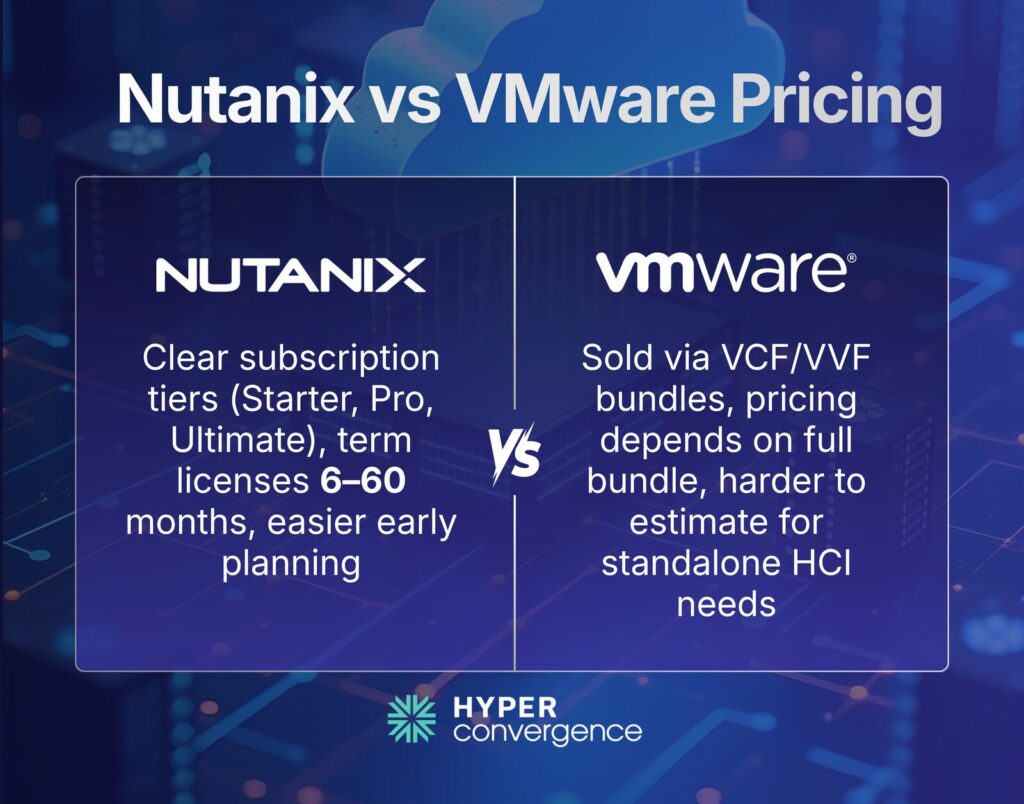
This is the biggest decision factor for most buyers. Nutanix includes the hypervisor and publicly lays out edition differences, which makes initial planning more straightforward. VMware’s current model centers on bundled subscriptions, so buyers need to check carefully whether they need VVF or the broader VCF bundle. That difference can shape both direct additional cost and long-term operational cost.
Nutanix often looks stronger when buyers want cost effectiveness, fewer moving parts, and less dependency on VMware licensing. VMware often looks stronger when a company already has a large VMware estate and wants to avoid the extra cost and disruption of platform change.
5. Performance and Scalability
Both platforms support enterprise workloads and horizontal scaling. Nutanix Starter supports clusters up to 12 nodes, while larger editions remove that limit. Broadcom says vSAN clusters can scale beyond 32 hosts up to 64 hosts. VMware also recommends vSAN ESA for new deployments starting with vSAN 8, and Broadcom describes ESA as a high-performance architecture built around a single scale out architecture rather than classic disk groups.
Broadcom’s vSAN ESA materials also say the newer snapshot system can deliver snapshot consolidations more than 100x faster than older approaches. That is an important update because many older comparison articles do not reflect the current ESA picture. All flash configurations also improve performance for hyperconverged environment deployments.
6. Hybrid Cloud and Multi-Cloud Strategy
Nutanix offers a more direct hybrid and multicloud story in its public materials. Nutanix says NC2 lets buyers run and manage infrastructure across data centers, edge environments, and multiple public clouds as one unified cloud, and NC2 now runs on AWS, Azure, and Google Cloud. Google Cloud’s own launch post says NC2 on Google Cloud is generally available across 17 regions.
VMware’s current message is more private-cloud centered. Broadcom says VCF 9.0 gives customers a consistent operating model across data centers, edge, and managed cloud infrastructure from service providers and hyperscalers. That is still valuable, but it is a different story from Nutanix’s more direct multicloud portability message.
Nutanix also emphasizes compute, storage, and networking integration in a hyperconverged infrastructure approach for better high availability and data locality.
7. Support and Customer Experience
Support and customer experience matter because they affect daily operations after the sale. Broadcom says all VMware solutions now fall under Broadcom Software Maintenance, and some support requests may be routed to authorized partners. Nutanix, on the other hand, continues to present a more centralized platform and support story.
User review data currently leans slightly in Nutanix’s favor on customer sentiment. Gartner Peer Insights shows Nutanix Cloud Platform at 4.6 versus VMware vSAN at 4.5, and Gartner’s comparison pages note that Nutanix scored higher on service and support.
PeerSpot also shows 94% of Nutanix users willing to recommend the product versus 87% for VMware vSAN. These are not the only metrics that matter, but they do support Nutanix’s reputation for easier operations and stronger support. Consequently, many customers have access to cost-effective operations and full control over resources.
Buying Scenarios: Which Platform Fits the Most Common Real-World Situations
Scenario 1: You are a mid-market company refreshing aging virtualization infrastructure
Nutanix is usually the better fit here because it gives you the hypervisor, management layer, DR, lifecycle tools, and basic file or object capacity in one platform. That usually means less planning overhead and fewer product dependencies, and better cost predictability for a smaller IT landscape, improving its performance and operational scalability.
Scenario 2: You already run a large VMware estate and want the least disruptive next step
VMware vSAN is usually the safer fit here because it keeps storage, virtualization, and operations inside the VMware model your team already knows. That lowers change-management risk even if it gives you less flexibility later, while maintaining hardware consistency across clusters.
Scenario 3: You want a realistic path away from VMware dependency
Nutanix is the stronger option because it supports AHV, Microsoft Hyper-V, and ESXi during transition periods, and extends into the public cloud with NC2. That gives buyers more room to migrate in stages and leverage software defined infrastructure to reduce costs gradually, instead of taking one large cutover risk.
Scenario 4: You want the strongest fit for a broader VMware private cloud strategy
VMware vSAN makes more sense if your organization is already leaning into VVF or VCF and wants to keep building inside that model. In that case, continuity and platform consistency matter more than vendor diversification, while retaining strong data protection and compute storage and networking integration.
Scenario 5: You want a simpler multicloud story for future growth
Nutanix is easier to defend in this case because its cloud message is direct and up to date. NC2 already runs across AWS, Azure, and Google Cloud, and its Google Cloud launch expanded availability to more than a dozen regions at general availability. This improves scalability and performance for workloads across IT landscapes with mixed data and solutions.
Migration Considerations
Moving from VMware to Nutanix
Nutanix offers Nutanix Move as its migration tool, and its cloud materials say customers can move applications and data across clouds without refactoring. In practical terms, that gives buyers a workable migration route if they want to reduce costs alongside VMware dependence gradually rather than all at once.
Retraining is still part of the change, especially for teams used to VMware-first operations, but the platform is designed to support that transition path in hyperconverged infrastructure or vSAN solution scenarios.
Staying on VMware
Staying on VMware can still be the right move, but buyers should check the current lifecycle and licensing picture carefully. Broadcom says vSphere 7.x, vCenter 7.x, and vSAN 7.x reached the end of general support on October 2, 2025.
That means organizations still running those versions should treat this as an active planning issue and not a background task, especially when evaluating high-performance hyperconverged solutions and all-flash configurations.
How We Evaluated These Platforms
We compared these two prominent HCI platforms based on the following:
- Pricing structure and licensing flexibility
- Ease of deployment and management
- Feature depth and ecosystem
- Vendor lock-in risk
- Real-world usability and customer feedback
- Recent industry changes after the Broadcom acquisition
Nutanix vs VMware vSAN: Which HCI Platform Should You Choose?
Choose Nutanix if:
- You want simpler operations
- You need cost predictability
- You want hypervisor flexibility
- You are building a hybrid or multicloud strategy
- You want a strong HCI platform without a deeper VMware dependency
Choose VMware vSAN if:
- You are already invested in VMware
- You need deep ecosystem integration
- Your team depends on VMware tools
- You are comfortable with VVF or VCF as the buying model
- You want continuity over change
Bottom Line: Nutanix is the better choice for most mid-market buyers and cost-conscious organizations. VMware vSAN remains a strong option for enterprises that are deeply embedded in the VMware ecosystem and want to stay there.
To compare real pricing from Nutanix and VMware partners in minutes, request a free HCI quote based on your infrastructural demands, and decide on the better business deal.
Conclusion
Nutanix and VMware vSAN are both strong HCI platforms, but they serve different priorities. Nutanix offers a full HCI stack in one place and gives buyers flexibility around hypervisors and cloud strategy. VMware vSAN keeps storage within a broader VMware private cloud framework and works well for enterprises with a strong VMware foundation.
So, the best platform is the one that matches your operational model, contract approach, and migration goals; not the one with the most features. For a final buying decision, request a personalized HCI quote that covers software, support, migration effort, and your target cloud plan. This will give you a clearer picture than any generic price sheet.
FAQs
Nutanix is usually the better fit for teams that want a more unified HCI stack, simpler day-to-day management, and a VMware exit path.
No. Nutanix does not use VMware vSAN as its core storage layer. Nutanix uses AOS and its Distributed Storage Fabric, though Nutanix can run with VMware ESXi as a hypervisor and can reuse some former vSAN Ready Node hardware.
Nutanix is best known for helping popularize hyperconverged infrastructure and for combining storage, compute, virtualization, and management into one platform. Its best-known building blocks are AOS, Prism, AHV, and its hybrid multicloud positioning.
Nutanix trade-offs usually include committing to the Nutanix software stack, cluster-wide per-core licensing, and retraining or migration work for VMware-focused teams. Those issues matter most when an organization already has mature VMware tools, skills, and operating patterns.
Broadcom is an American company. Broadcom describes itself as a Delaware corporation and lists its corporate headquarters in Palo Alto, California, United States
In enterprise HCI and private cloud discussions, VMware, especially VMware vSAN and VMware Cloud Foundation, is usually treated as Nutanix’s main competitor.
Nutanix is often easier to manage for general HCI operations because Prism combines infrastructure functions in one interface. VMware vSAN can still feel easier for teams already deeply familiar with vCenter, vSphere, and the broader VMware stack.
The migration is usually moderate in difficulty, not effortless, but very manageable with planning. Nutanix provides product mapping guidance and the Nutanix Move tool to shift workloads from VMware environments onto AHV and Nutanix storage.
Nutanix NCI uses per-core licensing across the cluster, while VMware vSAN is packaged inside VMware vSphere Foundation or VMware Cloud Foundation subscriptions. Nutanix pricing is often simpler to understand, but the actual cost depends on bundles, add-ons, and hardware plans.
Yes, for many teams. Nutanix is a good VMware vSAN replacement if you want integrated storage, virtualization, and management, plus supported migration tools.