

Web hosting underpins nearly all online activity, from small business sites to global e-commerce platforms. In 2026, the industry is a multi-hundred-billion-dollar ecosystem shaped by evolving web hosting environments, greener renewable energy hosting, next-gen cloud servers, and growing attention to cloud security statistics as organizations reassess risk, compliance, and infrastructure resilience.
As of early 2026, there are over 1.5 billion websites worldwide (of which <200 million are active).
This article compiles 100+ key statistics on the web hosting sector to help businesses, developers, and digital teams understand the shifts in hosting infrastructure. You will learn about the most important web hosting statistics, including market size and growth, provider market share, domain volumes, technology usage, pricing, global demand, and performance.
Recent industry research shows rapid expansion: for example, global hosting revenue grew from ~$130.1 billion in 2023 to ~$159.9 billion in 2024, and is forecast to reach ~$355.8 billion by 2029. (source)
Key Categories Covered:
- Market Size & Growth (global and historical trends)
- Regional and Country Market Share
- Top Hosting Providers (market share)
- Hosting Service Segments (shared, VPS, cloud, dedicated)
- Domain & Website Volumes
- Technology Usage (CMS, web servers, programming languages)
- Pricing and Spending Trends
- Performance and Uptime Metrics
- Emerging Trends (security, sustainability, cloud adoption)
Global Trends in Web Hosting: Market Size & Growth
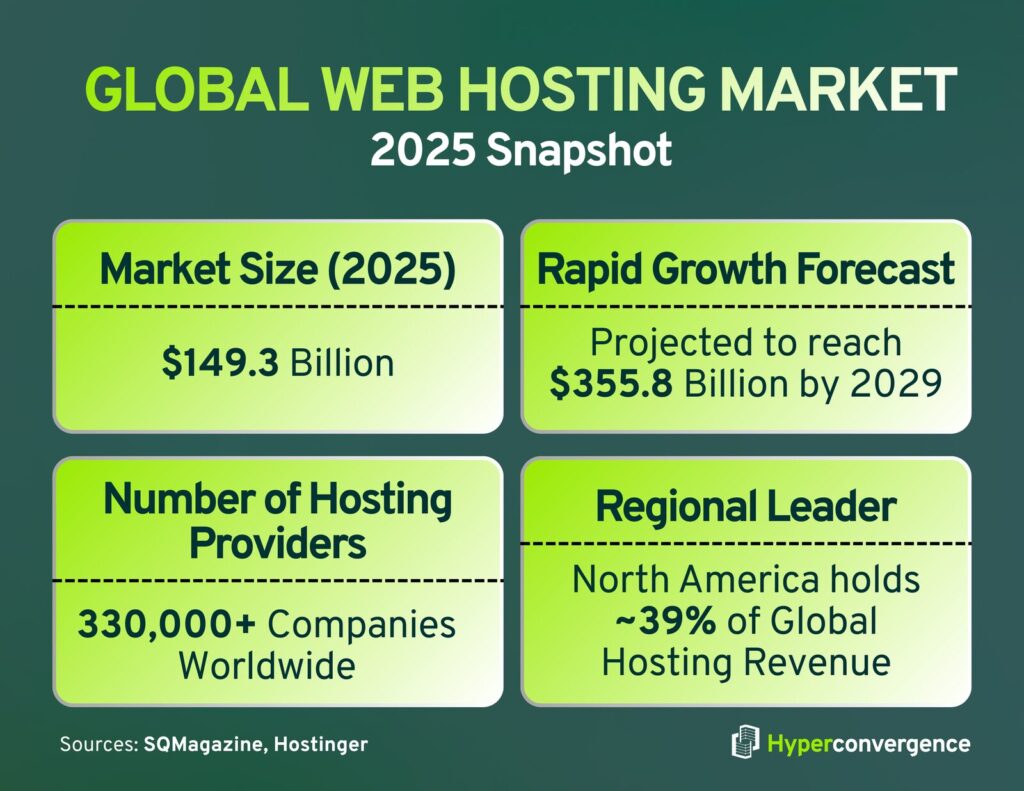
- The global web hosting market is valued at ~$149.3 billion in 2025, up from ~$126.4 billion in 2024. (SQMagazine- Web Hosting Statistics 2025)
- Forecasts project growth to $355.8 billion by 2029 (Hostinger- Web Hosting Statistics 2025), and ~$527.1 billion by 2032. (SQMagazine- Web Hosting Statistics 2025)
- One analysis shows growth from $130.10 B (2023) to $159.90 B (2024), a ~23% increase. Consensus CAGR estimates range roughly 17–23% for 2024–2029. (Web Hosting Market Data-Openprovider)
- Historical Growth: The industry has more than doubled since 2018. For instance, revenue was ~$59.14 B in 2020 and ~$96.91 B in 2022 (demandsage), climbing to $130.10 B in 2023. (Web Hosting Market Data-Openprovider)
- One forecast calls for a 23.6% CAGR (2025–2029), while another projects ~19.7% (2025–2032). (SQMagazine- Web Hosting Statistics 2025)
- There are 300K+ hosting companies operating globally- one estimate cites >330,000 providers worldwide as of 2025. (Hostinger- Web Hosting Statistics 2025)
Hosting businesses are highly fragmented, but consolidation by hyperscalers (cloud providers) is increasing.
- North America leads the market: Roughly 39% share of global hosting revenue is projected in 2025. (Hostinger- Web Hosting Statistics 2025)
- The U.S. alone generated about $57.74 billion in 2024. (Web Hosting Market Data-Openprovider)
- The U.S. hosting market is forecast to grow from $44.75 B (2025) to $127.17 B (2029). (Hostinger- Web Hosting Statistics 2025)
- Growth drivers: E‑commerce expansion, cloud adoption, AI-powered site builders, and digital transformation fuel demand. Conversely, commoditization has driven hosting prices downward.
- For example, the average first-term shared hosting promo price fell from ~$3.70/month in 2020 to ~$2.33 in 2024 (a ~37% decline). (Web Hosting Market Data-Openprovider)
Despite lower retail prices, operational costs are rising (energy, compliance, security), pushing hosts toward automation and value-added services.
- Spending: Businesses spend more on infrastructure. In 2025, the average spend per employee in the hosting market is projected to reach $52.44 globally, reflecting higher digital investments by IT teams. (Hostinger- Web Hosting Statistics 2025)
Regional & Country Breakdown
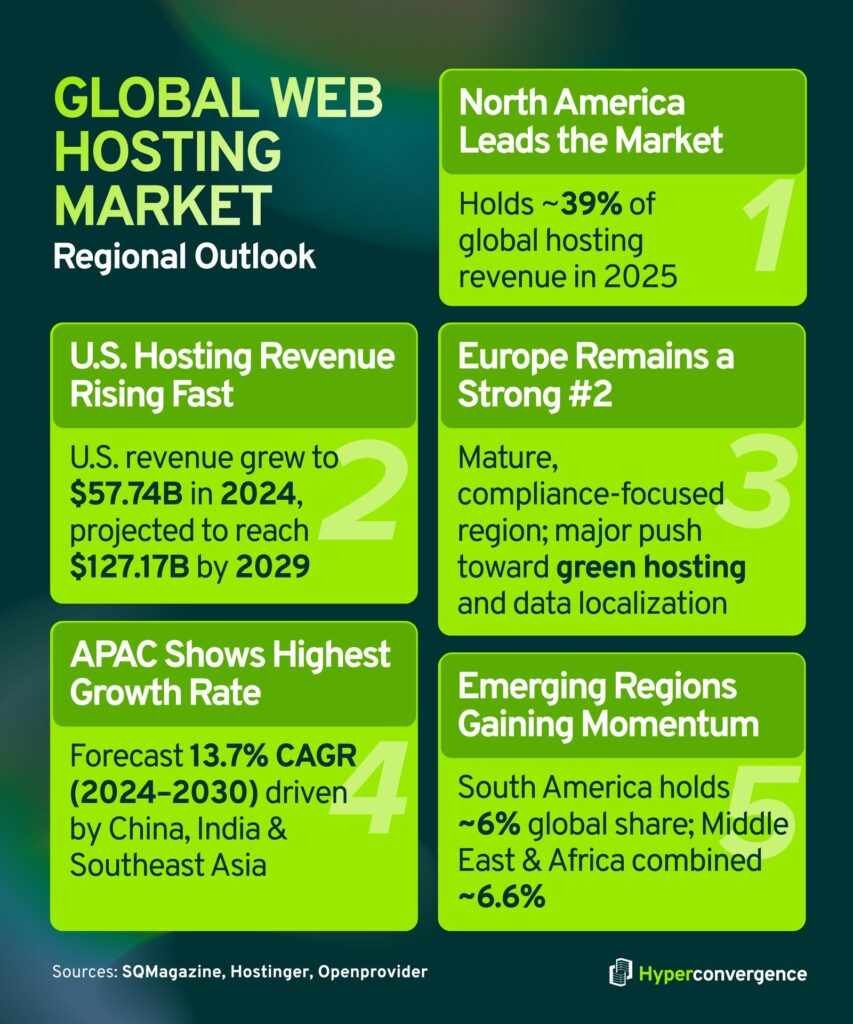
- North America: Dominant region. Expected to account for ~39% of the global market in 2025. (Hostinger- Web Hosting Statistics 2025)
- North American (primarily U.S.) revenue grew from ~$45.15 B in 2023 to $52.14 B in 2024 (SQMagazine- Web Hosting Statistics 2025), with $57.74 B in U.S. revenue (2024). (Web Hosting Market Data-Openprovider)
- Europe: The second-largest region by revenue. Europe’s mature markets support strong demand for hosting and compliance-heavy services. (Exact share varies by source; one analysis notes Europe “trails North America” but remains a heavyweight. (SQMagazine- Web Hosting Statistics 2025)
Europe is also pushing green hosting and localisation.
- Asia-Pacific (APAC): Rapid growth region. Strong internet adoption and e‑commerce in China, India, and SEA drive hosting demand. APAC is forecast at ~13.7% CAGR (2024–2030). In many forecasts, APAC is the second or third-largest region by 2030. (SQMagazine- Web Hosting Statistics 2025)
- South America: Smaller share (~6% of the global market) but consistent growth. E‑commerce and cloud adoption in Brazil and Mexico are contributing to double‑digit growth rates. (SQMagazine- Web Hosting Statistics 2025)
- Middle East & Africa: Combined ~6.6% of global share (Middle East ~3.8%, Africa ~2.8% in 2025). (SQMagazine- Web Hosting Statistics 2025)
- Growth potential is high due to under‑penetrated markets and new data centre investments (e.g., UAE, South Africa).
- Country Highlights: The U.S. is by far the largest single-country market. Other leading markets include China, Germany, the UK, and India (all with substantial hosting infrastructure and customer bases). For example, the U.S. web hosting market alone is projected to hit $127.17 B by 2029.
Top Hosting Providers & Market Share Statistics
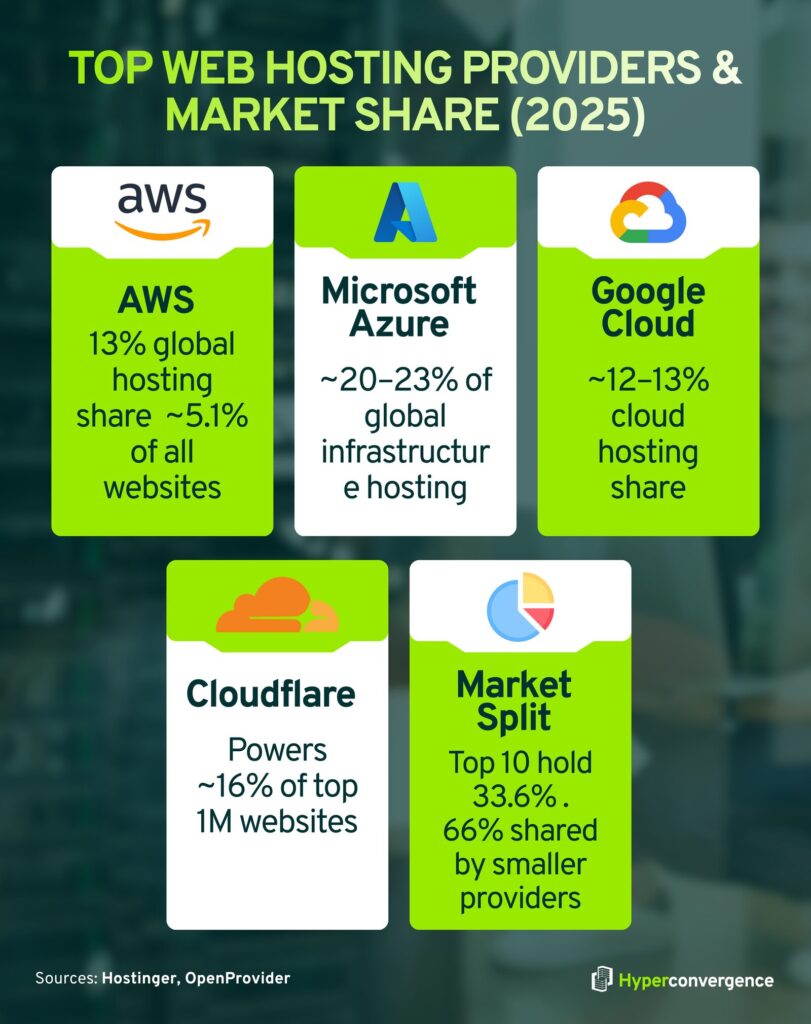
- AWS (Amazon Web Services): Leads among providers. One estimate attributes ~13% of the global hosting market to AWS. (Web Hosting Market Data-Openprovider)
- AWS “powers” roughly 5.1% of all websites worldwide, making it the single largest web hosting vendor by volume. (Hostinger- Web Hosting Statistics 2025)
- Microsoft Azure: Major provider with ~20–23% market share (infrastructure layer). Enterprises often use Azure for hosting and PaaS services. (Web Hosting Market Data-Openprovider)
- Google Cloud: Holds about 12–13% of the cloud hosting market. (Web Hosting Market Data-Openprovider)
- Together, Azure and Google Cloud (with AWS) account for the vast majority of global cloud infrastructure- the “Big Three” cloud providers collectively cover roughly 80% of the global cloud hosting layer. (Hostinger- Web Hosting Statistics 2025)
- Cloudflare: While mostly a CDN and security platform, Cloudflare delivers hosting services (Workers, Pages). Notably, Cloudflare serves ~16% of the top 1 million websites, indicating its strong position among high-traffic sites. (Hostinger- Web Hosting Statistics 2025)
- Hostinger: A major share in the SMB market. Hostinger holds about 4.1% of the global web hosting market and powers ~1.43% of the top million sites. (Hostinger- Web Hosting Statistics 2025)
- It has seen rapid growth (~50% increase in market share in the past year) due to competitive pricing and performance.
- Top 10 Companies: The top ten hosting providers together control about 33.6% of global market revenue. (Hostinger- Web Hosting Statistics 2025)
This indicates that most of the market is fragmented: two-thirds of hosting is handled by thousands of smaller firms and resellers.
- Other Players: GoDaddy (and related brands) is often ranked among the largest, with ~9–10% share; Google (the company) also sells hosting (~7%). But those figures vary by source. Small and niche hosts (e.g., DreamHost, SiteGround, A2, etc.) each hold low single-digit market shares.
- Multi-Cloud: Among large organisations, multi-cloud strategies are standard: one survey found 87% of respondents using multiple cloud providers. (Flexera)
(This underscores that many businesses combine AWS, Azure, GCP, etc., rather than relying on one vendor.)

Statistics of Hosting Service Segments
Shared Hosting
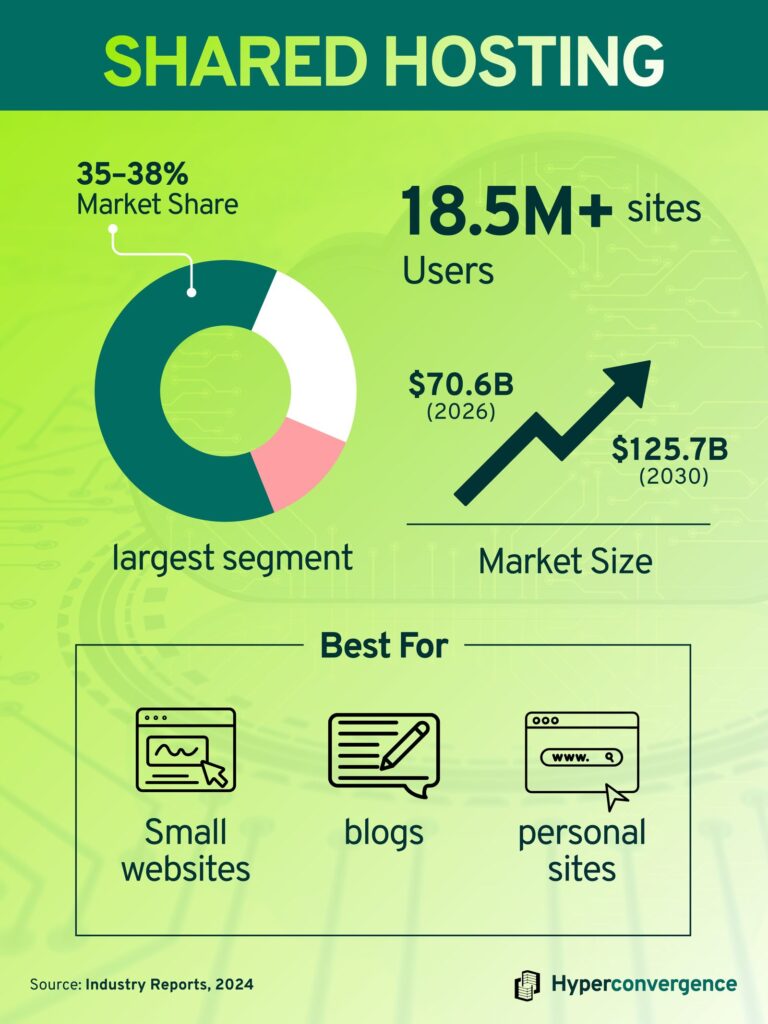
- The largest segment by volume. Shared hosting is used by millions of small websites. It represents roughly 35–38% of total hosting revenue and an even larger share of total hosted sites globally. (SQMagazine- Web Hosting Statistics 2025)
- Over 18.5 million websites (mostly SMB and personal sites) still use shared hosting in 2025. (SQMagazine- Web Hosting Statistics 2025)
- The shared hosting market is projected to reach $70.6 B by 2026.
- By 2030, shared hosting is forecast at ~$125.7 B (implying ~15.5% CAGR from 2024). (SQMagazine- Web Hosting Statistics 2025)
Dedicated Servers
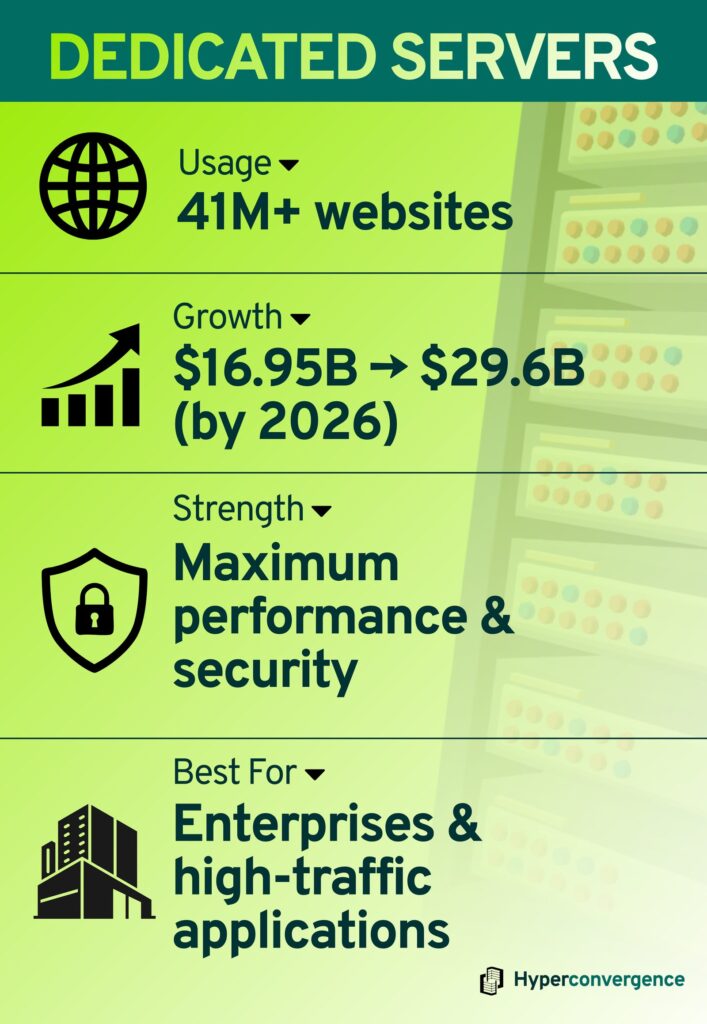
- Enterprise-class servers remain important for high-traffic or high-security sites. The dedicated hosting segment is growing fast: revenue is expected to rise to $29.6 B by 2026 (from $16.95 B in 2023), a ~18.9% CAGR. (Hostinger- Web Hosting Statistics 2025)
- Over 41 million websites currently run on dedicated servers (often for performance or security reasons). (Hostinger- Web Hosting Statistics 2025)
Virtual Private Servers (VPS)
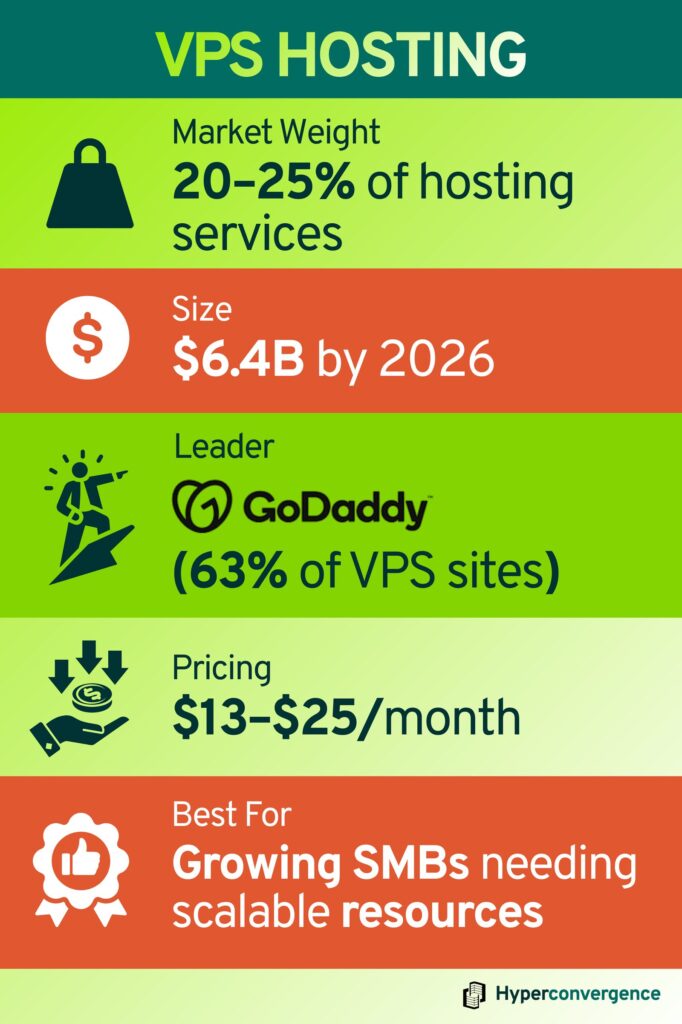
- VPS hosting (virtual machines) bridges shared and dedicated servers. Forecasts indicate VPS will make up roughly 20–25% of all hosting services by 2025. (SQMagazine- Web Hosting Statistics 2025)
- The VPS market is projected at $6.4 B by 2026, growing about 11.9% annually. (SQMagazine- Web Hosting Statistics 2025)
- Managed VPS offerings are growing faster (~16.5% CAGR). (SQMagazine- Web Hosting Statistics 2025)
- GoDaddy dominates the VPS segment, powering around 63% of VPS-hosted sites. (SQMagazine- Web Hosting Statistics 2025)
- Entry-level VPS plans average $13–$15/month, while mid-tier VPS plans average $21.89–$25.17/month. (SQMagazine- Web Hosting Statistics 2025)
Cloud & Managed Hosting
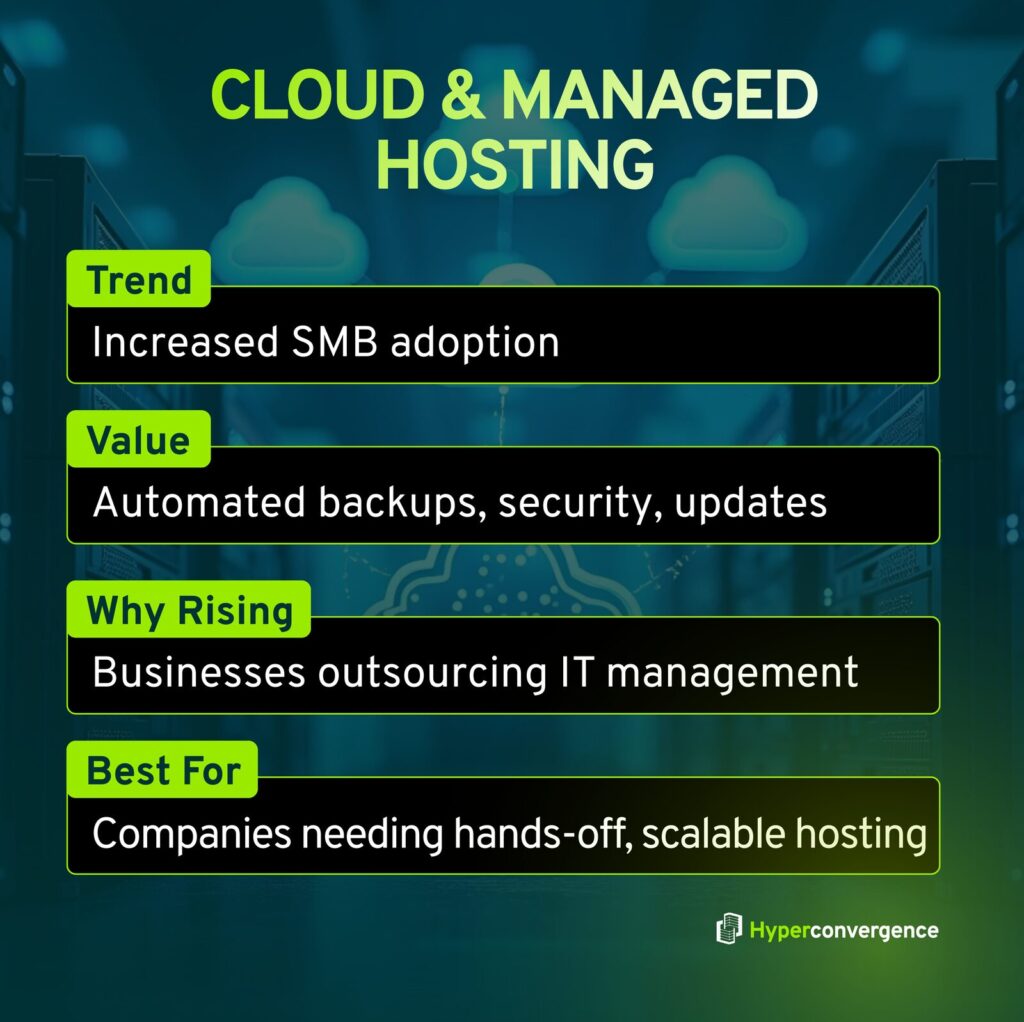
- “SMBs increasingly use cloud hosting” (public cloud VMs/storage). Exact cloud share is often included in VPS or by hyperscaler stats above.
- Managed hosting (including managed WordPress) is growing as businesses outsource IT. For example, shared hosting plans now often include built‑in security, backups, and automation to differentiate beyond just server space (due to price pressure). (Web Hosting Market Data-Openprovider)
Reseller Hosting

- An important niche where agencies and hosting resellers bundle multiple services. Prices in the entry-level reseller market have been driven down (race to the bottom). (Web Hosting Market Data-Openprovider)
- Many resellers now focus on automation and value-adds to stay profitable.
Domain Name & Internet Infrastructure Statistics
Domains
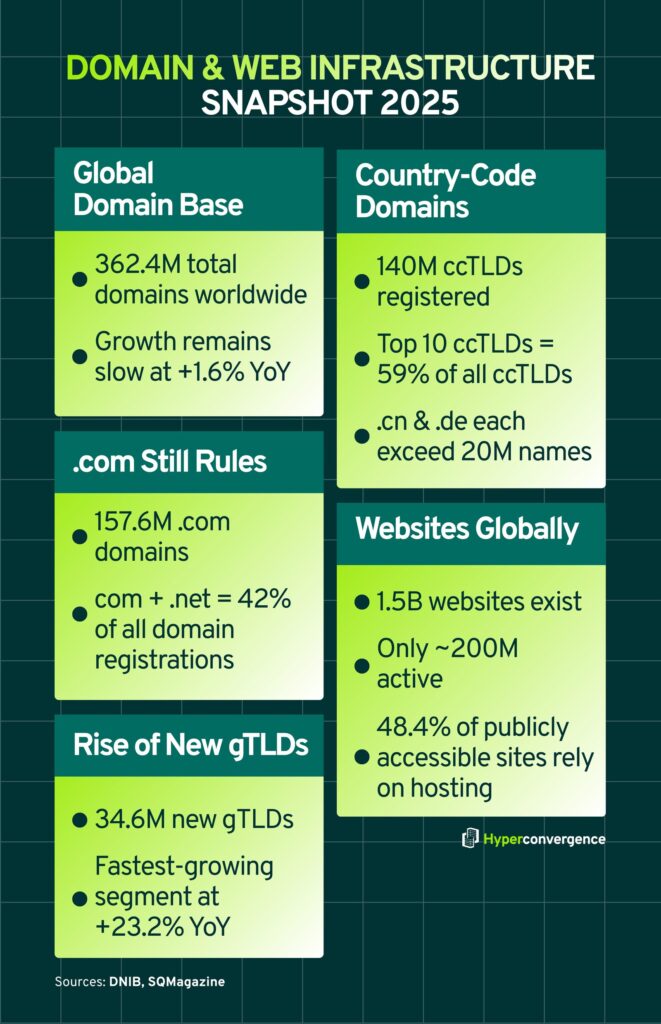
- The total global domain name base reached ~362.4 million at mid-2024 (all TLDs), essentially flat (+1.6% YoY). (The DNIB Quarterly Report Q2 2024)
- Of these, top-level domains (gTLDs + ccTLDs) include: .com/.net combined had 170.6 million registrations (42% of the base) by Q2 2024. The .com TLD alone held 157.6 million names. (The DNIB Quarterly Report Q2 2024)
Country-Code TLDs (ccTLDs):
- There were ~316 ccTLD extensions (including IDNs) in mid-2024. (The DNIB Quarterly Report Q2 2024)
- Total ccTLD registrations were 140.0 million in Q2 2024 (up 2.2% YoY). The 10 largest ccTLDs (e.g., .cn, .de, .uk, .ru) accounted for 59.0% of all ccTLD registrations. (The DNIB Quarterly Report Q2 2024)
- For example, China’s .cn and Germany’s .de each have over 20 million domains.
New gTLDs:
- Non‑legacy TLDs (like .xyz, .online, .app, etc.) saw 34.6 million registrations in Q2 2024, up 23.2% YoY.
- The top 10 gTLDs (e.g., .com, .net, .org, .xyz, .info) comprised ~90.1% of all new gTLD registrations (and 55.3% of all TLD registrations). This shows that legacy extensions (.com/.net/.org) still dominate overall domain count. (The DNIB Quarterly Report Q2 2024)
Websites:
- As noted above, 1.5 billion websites exist (internetlivestats), but many are parked or inactive. Only ~200 million are in active use.
- The number of sites has grown rapidly (the 1 billion mark was first reached in 2014. (internetlivestats)
- About 48.4% of publicly accessible sites use hosting (the rest are intranets or offline). (SQMagazine- Web Hosting Statistics 2025) (Websites are hosted on the providers above.)
Data Centres
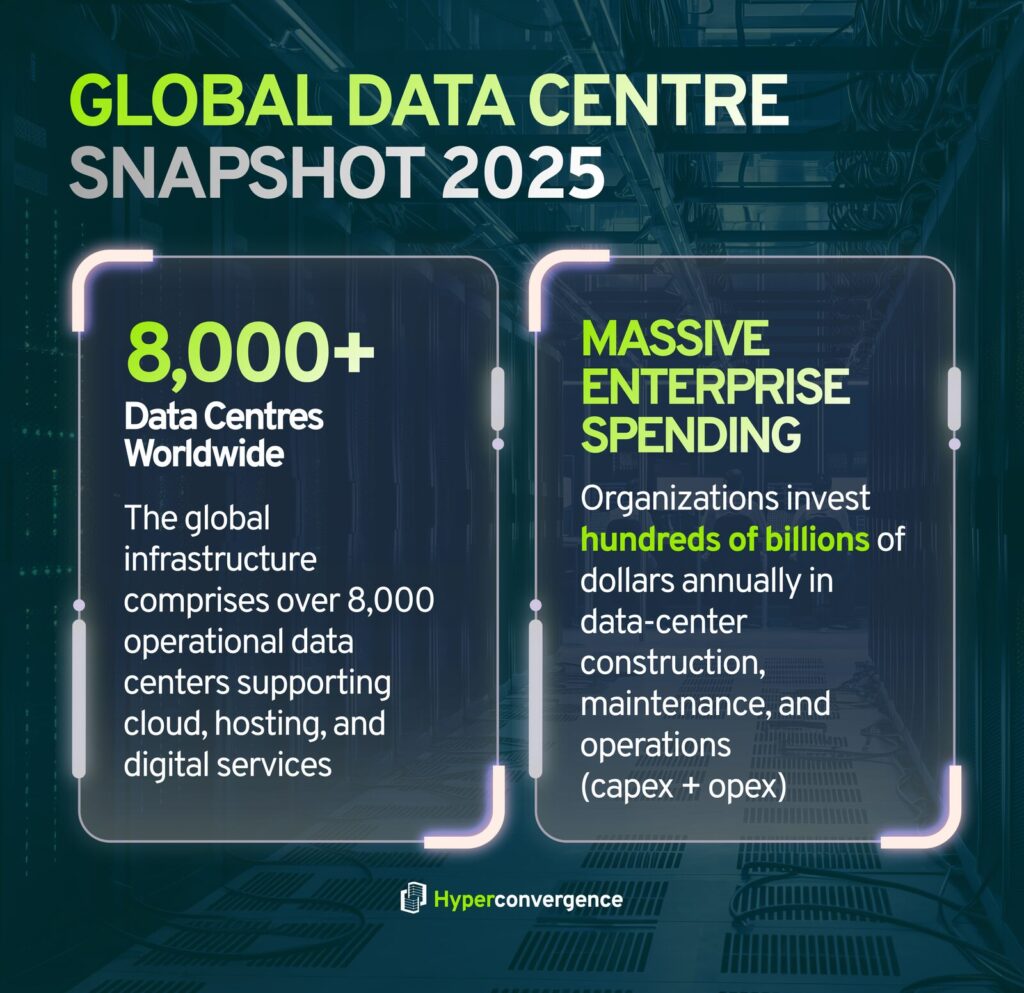
- Over 8,000 data centres operate worldwide, and enterprise spending on data centre capex/opex is in the hundreds of billions annually.
- Many hosts operate Tier‑3/4 facilities with 99.982%–99.995% uptime guarantees, though only some publish uptime statistics.
Website Technology & CMS Usage
Web Servers
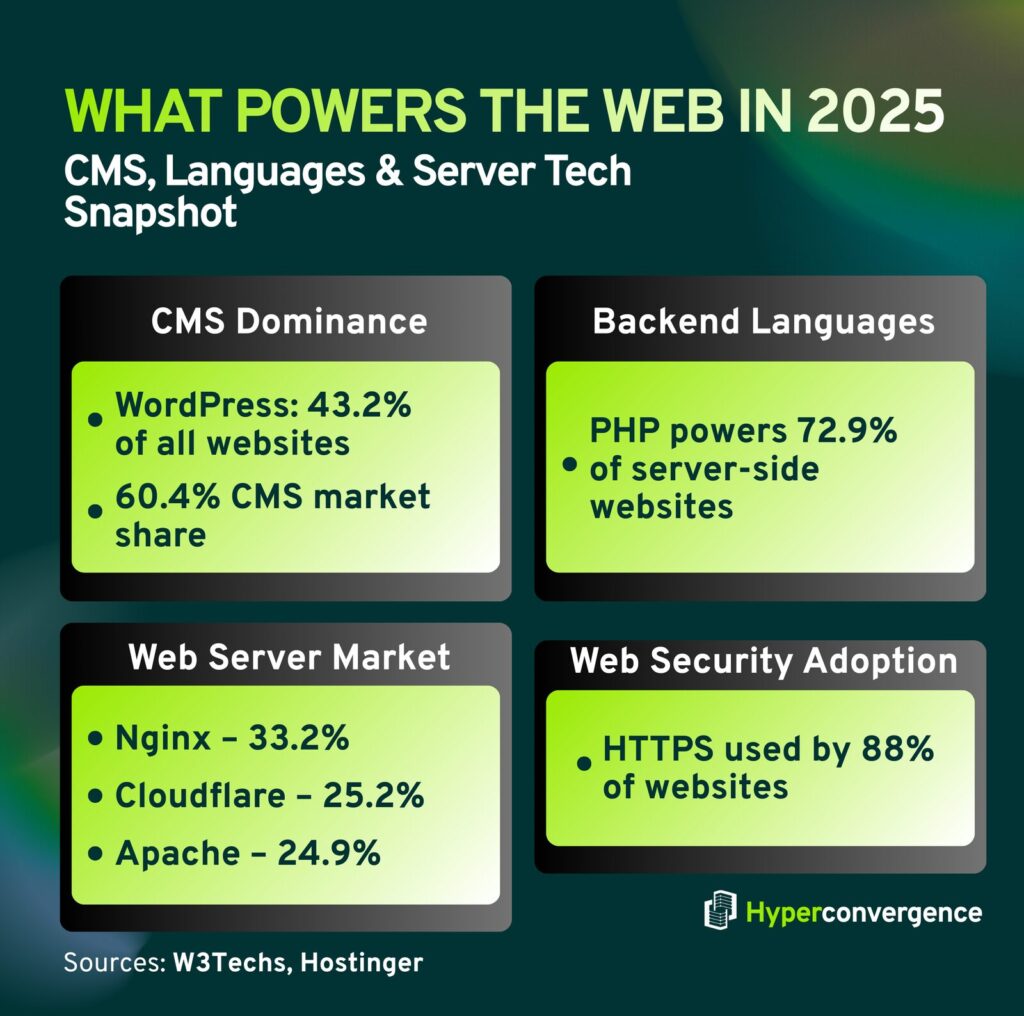
- Nginx is the most popular web server (used by 33.2% of all websites). (w3techs)
- Cloudflare’s server is next at 25.2%, followed by Apache at 24.9% (w3techs).
- LiteSpeed serves 14.9% of sites. (w3techs)
- Other servers like Microsoft-IIS, Node.js, etc., each have a <6% share.
- In top-ranked sites (top million), the distribution is similar, though Nginx and Cloudflare often rank higher.
Programming Languages
- On the server side, PHP dominates: ~72.9% of websites use PHP as a server-side language. (w3techs)
- Other languages (Python, Ruby, Java, NET) are far less common.
- Among PHP users, PHP 8 is used by 53.9% of PHP-based sites, PHP 7 by 36.6%, and older versions account for the remainder. (w3techs) (Regular updates to PHP can improve performance and security.)
CMS Platforms
- Content management breakdown: WordPress powers 43.2% of all websites (w3techs) (roughly 60.4% market share among sites using a CMS).
- Other platforms are far behind: Shopify ~4.9%, Wix ~4.1%, Squarespace ~2.4%. (w3techs)
- Joomla, Drupal, Webflow, etc., each has a <2% share.
- In sum, >28% of sites run without a “monitored” CMS (custom or static). (w3techs).
- The dominance of WordPress highlights that most of the web’s CMS-based content is on one platform.
Website Performance
- Page speed is critical. Surveys find 47% of users expect page load in 2 seconds or less. (Hostinger- Web Hosting Statistics 2025)
- Performance directly affects retention and SEO. (Not surprisingly, most hosts now offer SSDs, CDNs, and caching by default.)
Security Adoption
- HTTPS is now ubiquitous- 88% of websites use HTTPS as the default protocol. (Hostinger- Web Hosting Statistics 2025)
- SSL/TLS certificates are almost universally included with hosting plans. Providers and users are also increasingly adopting WAFs and DDoS protection (Cloudflare usage, 2FA, etc.).
Other Tools
- Content Delivery Networks (CDNs) are widely used (e.g., Cloudflare’s 16% among top sites). (Hostinger- Web Hosting Statistics 2025)
- Automated site builders (WordPress page builders, Headless CMS, etc.) are on the rise. Managed WordPress or managed cloud hosting tiers (with auto-scaling/AI features) are growing in demand. (SQMagazine- Web Hosting Statistics 2025)
Pricing, Cost & Spending Trends
Shared Hosting Plans
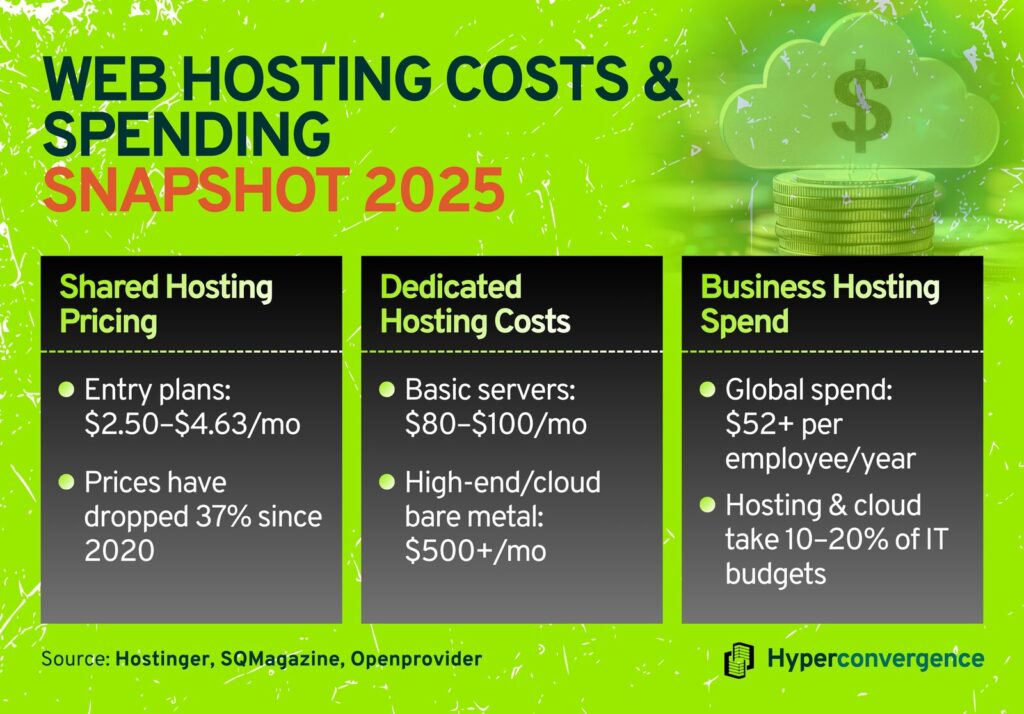
- Entry-level shared hosting is very cheap. As of 2025, introductory prices average about $2.50–$4.63 per month. (SQMagazine- Web Hosting Statistics 2025)
- Mid-tier shared plans are typically $4.63–$6.52/month. (SQMagazine- Web Hosting Statistics 2025)
- In contrast, annual or multi-year plans may effectively be under $1/mo. Such low pricing reflects intense competition.
Dedicated Plans
- Dedicated server hosting ranges from ~$80/mo for basic models up to $500+ per month for high-end enterprise servers. (Hostinger- Web Hosting Statistics 2025)
- GPU/AI servers and large-scale clusters cost more.
- Typical entry dedicated servers start around $80–$100/mo, while providers like AWS/Google offer bare metal servers in the $500/mo range.
Price Trends
- First‑term shared hosting promo rates fell ~37% from 2020 to 2024. (Web Hosting Market Data-Openprovider)
- Many hosts now bundle cPanel/WHMCS licenses (or their own control panels) to remain profitable.
- Despite lower service prices, infrastructure costs (e.g., energy, hardware) are rising. This leads to bundling of backup/security add-ons by hosts. (Web Hosting Market Data-Openprovider)
Spending:
- Enterprises and SMBs allocate steadily higher budgets to hosting/cloud. For example, global per-employee spend on hosting services is over $52 per year (2025). (Hostinger- Web Hosting Statistics 2025)
- Overall, IT budgets often dedicate 10–20% to hosting and cloud infrastructure. Cloud migration and redundancy (multi-cloud) are significant drivers of spend.
Payment Methods:
- Most web hosting customers pay via credit card or PayPal monthly/annually. The shift toward annual plans (to lock in customers) is notable, but data on payment mix is scarce.
- Some hosts now accept cryptocurrency payments as an option.
Performance, Reliability & Uptime Statistics

User Expectations:
- Nearly half of end users (47%) expect a website to load in 2 seconds or less. (Hostinger- Web Hosting Statistics 2025)
- A delay as small as 100 milliseconds in page load time can reduce conversion rates by up to 7%. (Akamai’s State of Online Retail Performance Report- 2017)
Downtime Impact:
- While most hosts offer 99.9%+ uptime SLAs, outages can be costly.
- Though specific stats for “cost per hour” vary by industry, one survey found 98% of orgs say 1 hour downtime costs >$100K. (Site Qwality)
- Typical uptime guarantees range from 99% (up to ~3.65 days downtime/year) to 99.99% (5.26 minutes/year) (amazee.io)
- Providers with global data centres (AWS, Cloudflare, Google) boast “five nines” uptime, though real-world outages still occur.
HTTPS & Security:
- As noted, 88% of sites use HTTPS, up from ~50% a few years ago. (Hostinger- Web Hosting Statistics 2025)
- More hosts now include free SSL certificates. 24/7 DDoS protection and automated security scans are common add-ons.
- Around 70–80% of new breaches target exposed web services, so active intrusion prevention (firewall, patching) is a growing focus in hosting packages.
Scaling & Redundancy:
- Modern hosting often uses auto-scaling (especially cloud). Surveys show ~87% of enterprises maintain multi-cloud/hybrid deployments, which improves resilience. (Flexera)
- Smaller hosts are increasingly offering staging/test copies, one-click recovery, and geo‑replicated backups.
Emerging Trends & Industry Insights
Green Hosting:
- Environmental concerns are rising. “Green hosting” (powered by renewable energy) is a fast-growing niche.
- Demand for sustainability in hosting is mounting – consumers and regulators increasingly require data centres to run on renewables. (SQMagazine- Web Hosting Statistics 2025)
- Several major providers (Google, AWS, Microsoft) have pledged to reach carbon neutrality by the mid-2020s. Some hosts now publish their carbon footprint per site.
Automation & AI:
- AI tools are being integrated into hosting. Machine learning is used for predictive maintenance, anomaly detection, and auto-scaling.
- Many hosts now include managed AI platforms (GPUs, frameworks). In 2024–25, AI/ML workloads became the leading new PaaS trend in cloud usage. (Flexera)
- Auto-provisioning and APIs (infrastructure-as-code) are standard for cloud hosting customers.
Bundled Services:
- As raw hosting margins shrink, providers emphasize managed services. For example, many now offer managed backup, security (WAF, malware scanning), and 24/7 support “as a service”. SSL/TLS adoption is nearly universal. (SQMagazine- Web Hosting Statistics 2025)
- Managed WordPress hosting has grown, with specialised stacks and auto-updates. DNS and domain registration are often bundled with hosting packages.
Security Features:
- Hosting often includes built-in security: two-factor auth, intrusion detection, and DDoS mitigation. Some reports note a sharp rise in hosts offering free weekly malware scans and firewall configuration (specific stats lacking, but qualitative trend).
Market Consolidation:
- Cloud giants (AWS, Google, Microsoft) continue expanding their hosting offerings (including managed database, CDN, IoT services). They are indirectly putting price pressure on smaller hosts. Meanwhile, large telcos and data centre companies (e.g., Equinix, Digital Realty) are growing in the hosting supply chain.
Final Insights on Web Hosting Statistics: What These Numbers Mean for You
The web hosting industry is large and fast-moving, and the web hosting market is projected to reach $355.8B by 2029, underscoring continued investment in hosting, cloud, and managed services. (source)
As a result, the risk surface expands- domain counts rise, hosting types diversify, and dependencies on large providers increase. The fragmentation (hundreds of thousands of web hosting companies) means many small players alongside major vendors such as AWS, Google Cloud, Azure, Hostinger, Cloudflare, and GoDaddy.
For enterprises and security leaders, this underscores:
- The importance of thorough vendor due diligence: monitor uptime SLAs, data residency, patching schedules, backup frequencies, and supply chain dependencies (CDNs, third-party providers).
- Balance between cost savings (cheap shared hosting) and risk: shared hosting remains viable for small static sites, but mission-critical applications favour dedicated, VPS, or cloud hosting with managed security.
- Importance of performance and compliance, as internet users expect fast load times, hosts now integrate CDN, caching, and edge computing to meet demand.
- Controlled growth strategy with market trends favouring cloud, managed, and hybrid hosting, organisations should adopt multi-cloud solutions or hybrid architectures to avoid vendor lock-in and optimise uptime, security, and flexibility.
FAQs
Web hosting is a service where web hosting providers store website files on servers and deliver them to visitors over the internet. It supports business operations by supplying storage, DNS, bandwidth, and secure hosting environments.
The global web hosting market continues to expand as the number of websites globally increases. Forecasts project revenue reaching approximately $356 billion by 2029, indicating strong demand for cloud hosting, dedicated hosting, and managed hosting services.
The largest web hosting providers include AWS, Google Cloud Platform, and Microsoft Azure, dominating the global web hosting and cloud hosting market share due to scale, reliability, and extensive hosting environments. (source)
Nginx leads, followed by Cloudflare Server, Apache, and LiteSpeed. These power millions of WordPress sites and content management systems across websites globally. (source)
Industry data shows more than 330,000 web hosting providers worldwide, ranging from traditional hosting solutions to modern cloud hosting platforms that support small businesses and enterprises.
AWS, Shopify, Wix, GoDaddy, OVHcloud, and Hostinger rank among the largest global web hosting services by usage and revenue, powering millions of website owners worldwide. (source)
Shared hosting remains the most popular due to affordability, especially for small businesses. VPS, cloud hosting, and managed hosting services are growing rapidly as hosting environments become more scalable.
Yes, especially managed hosting services and cloud hosting. Providers offering security, server management, and business-focused web hosting solutions maintain strong profitability despite competition and vendor-lock-in challenges.
WordPress powers ~43% of websites globally and ~60% of CMS-based sites, dominating content management systems due to flexibility and extensive plugin ecosystems. (source)
Its ecosystem of 60k+ plugins, themes, and widespread managed WordPress hosting support makes it ideal for website owners and small businesses seeking scalable, reliable hosting.
Not always. Shared hosting from reliable hosting providers is suitable for new WordPress sites or small businesses, but limited resources and shared server environments may restrict growth.
E-commerce hosting requires higher security, PCI compliance, uptime guarantees, and scalable cloud hosting to support business operations, unlike traditional hosting solutions.
It’s a bundled system offering web hosting services, CDN, backups, WAF, domain tools, and server management, ideal for WordPress sites, cloud hosting setups, and small businesses needing simplicity.
Critical. Slow websites cost conversions. 53% visitors leave if a mobile site takes more than 3 seconds to load. Also, Akamai found that a 100ms delay reduces conversions up to 7%. Fast hosting environments and cloud hosting improve performance.
Shared hosting prices typically range $2–$10/month, making it the most accessible option among global web hosting services for small businesses and new website owners.
Slow websites increase abandonment and reduce revenue. Akamai links a 100-millisecond delay to 7% conversion loss, making reliable hosting essential for business operations.
There’s no universal best, to be honest. Top web hosting providers include Hostinger, SiteGround, and WP-specialists. You should choose based on performance, prices, hosting environments, and cloud hosting capabilities.
Yes. Flexera reports 89% of organisations use multi-cloud hosting. Businesses shift from traditional data centres to cloud hosting for scalability and reduced vendor lock-in.
According to the Verisign report, ~362.4M domain names are registered, supporting the expansion of global web hosting and content management systems.
The typical costing range of web hosting is:
Shared: $2–10/mo;
VPS: $10–100+;
Dedicated hosting: $80–500+; (source)
Actually, cloud hosting varies by usage. These ranges help website owners choose scalable web hosting solutions.
The key differences between shared, VPS, dedicated, and cloud hosting are as follows:
Shared Hosting- Multiple websites share the same physical server and resources.
VPS Hosting- A physical server is divided into virtual machines, each with dedicated resources.
Dedicated Hosting- One website (or client) gets full control of an entire physical server.
Cloud Hosting- Websites run on a distributed network of pooled servers that scale resources on demand.

Tamzid is a distinguished SEO writer with over six years of experience specializing in IT, technology, data centers, and cybersecurity. His expertise extends to hyperconverged infrastructure, where he delivers well-researched, high-ranking content that bridges technical accuracy with reader clarity. With a deep understanding of both search optimization strategies and advanced IT concepts, Tamzid produces authoritative material that engages industry professionals and decision-makers alike.