Top 10 Cloud Servers in 2026
- The global public-cloud revenue is forecast to hit nearly US $980.30 billion in 2025, with the largest share still held by SaaS at over US $428 billion.
- Projected to grow at 17.1% annually, the cloud market is expected to reach US$2.16 trillion by 2030.
The data above clearly shows how fast and vast the cloud market is evolving, and it’s not just an IT trend. But the question is, which platforms are truly worth your trust in 2026?
With pressure mounting on businesses to deliver faster and more scalable services, your choice of cloud server provider could make or break your infrastructure in the coming years- whether you’re managing enterprise workloads or running small business servers to support daily operations.
Among the top cloud servers in 2026, Amazon Web Services (AWS), Microsoft Azure, and Google Cloud Platform (GCP) continue to dominate the market, driving the majority of global cloud infrastructure growth.
But other major players are shaping the cloud landscape this year as well. Some emerging providers are challenging the giants with competitive pricing, regional data centers, and specialized solutions, and we’re breaking them all down in our list of the top 10 cloud servers of 2026.
What is a Cloud Server? How Does It Work?
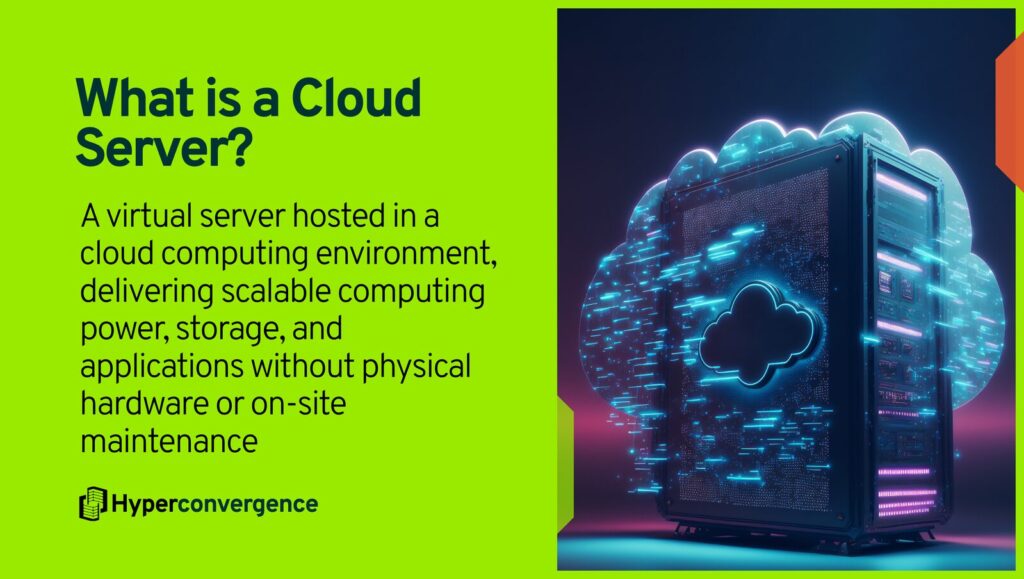
A cloud server is a virtual server that runs in a cloud computing environment instead of on physical hardware. It delivers computing power, storage, and applications to users over the internet, allowing businesses to scale quickly without owning or maintaining on-site servers.
Here’s how it works in simple terms:
- Virtualization technology divides physical servers into multiple virtual machines (VMs), each acting as an independent server.
- These VMs are hosted in data centers managed by cloud providers such as AWS, Azure, or GCP.
- Users access them remotely through a secure internet connection.
- Resources like CPU, memory, and storage can be scaled on demand, ensuring flexibility and cost efficiency.
In short, cloud servers combine the power of enterprise hardware with the flexibility of the web, making them the backbone of modern business operations.
Cloud Server vs Physical Server: Key Differences
Here are the key differences between cloud servers and physical servers, helping businesses choose the right solution for their web hosting and IT needs:
| Factors | Cloud Server | Physical Server |
| Infrastructure | Hosted virtually in a cloud hosting environment and managed by a third-party provider offering managed services and advanced cloud management tools. | Located on-site with dedicated hardware owned and maintained by the organization. |
| Setup Time | Quick setup, often ready within minutes, making it ideal for managed WordPress sites and scalable web hosting projects. | Takes longer to install, configure, and deploy. |
| Cost Structure | Pay-as-you-go model: businesses pay only for the resources they use, keeping cloud costs predictable and efficient. | Requires a large upfront investment for hardware and maintenance. |
| Scalability | Highly scalable; resources can be increased or decreased instantly through effective cloud server management. | Limited scalability; hardware upgrades are required for expansion. |
| Accessibility | Can be accessed remotely from anywhere with an internet connection. | Typically restricted to physical office locations unless remote access systems are installed. |
| Maintenance | Handled by the provider’s managed services, reducing the need for in-house IT support and ensuring smoother cloud management. | Managed by internal IT teams, including regular updates and hardware checks. |
| Reliability | High uptime with multiple backups and redundancy options, ensuring consistent performance across web hosting environments. | Risk of downtime due to hardware failures or power issues. |
| Security | Advanced security features, compliance standards, and encryption managed by the provider. | Security depends on in-house measures and physical data protection. |
| Performance | Flexible performance depending on resource allocation and provider network, suitable for managed WordPress and eCommerce hosting. | Consistent performance, limited by hardware specifications. |
| Disaster Recovery | Built-in backup and disaster recovery options, integrated into most cloud hosting plans. | Requires manual setup for data backup and recovery solutions. |
Types of Cloud Services
Cloud services have three main categories, each serving a different purpose:
1. Infrastructure as a Service (IaaS)
Offers virtualized computing resources like servers, storage, and networking. Users can manage operating systems and applications without owning physical hardware. According to Gartner, spending on IaaS is projected to reach approximately US $211.9 billion in 2025, growing at a rate of around 24.8% year-over-year.
2. Platform as a Service (PaaS):
Provides a ready-to-use environment for developers to build, test, and deploy applications without needing to manage the underlying infrastructure. Gartner estimates PaaS spending will hit roughly US $208.6 billion in 2025, up ~21.6 %.
3. Software as a Service (SaaS):
Subscription software that allows users to access tools like CRM, email, and collaboration apps directly through their browser. The Grand View Research report states that in 2024, the SaaS segment held approximately 54 % of the cloud market share.
In 2026, SaaS continues to lead the cloud market, with the global SaaS market projected to reach $315.68 billion, maintaining its position as the largest segment within the cloud industry.
CSP vs On-Premise Infrastructure: Why Businesses Are Choosing Cloud Servers in 2026?
Choosing a Cloud Service Provider (CSP) over on-premise infrastructure offers several key advantages that directly impact cost, performance, and scalability. This shift is also reflected in broader server and cloud infrastructure trends. See our latest server statistics for data on cloud infrastructure spending, workload adoption, server shipments, and market growth.
However, here’s why more businesses are moving their workloads to the cloud in 2026:
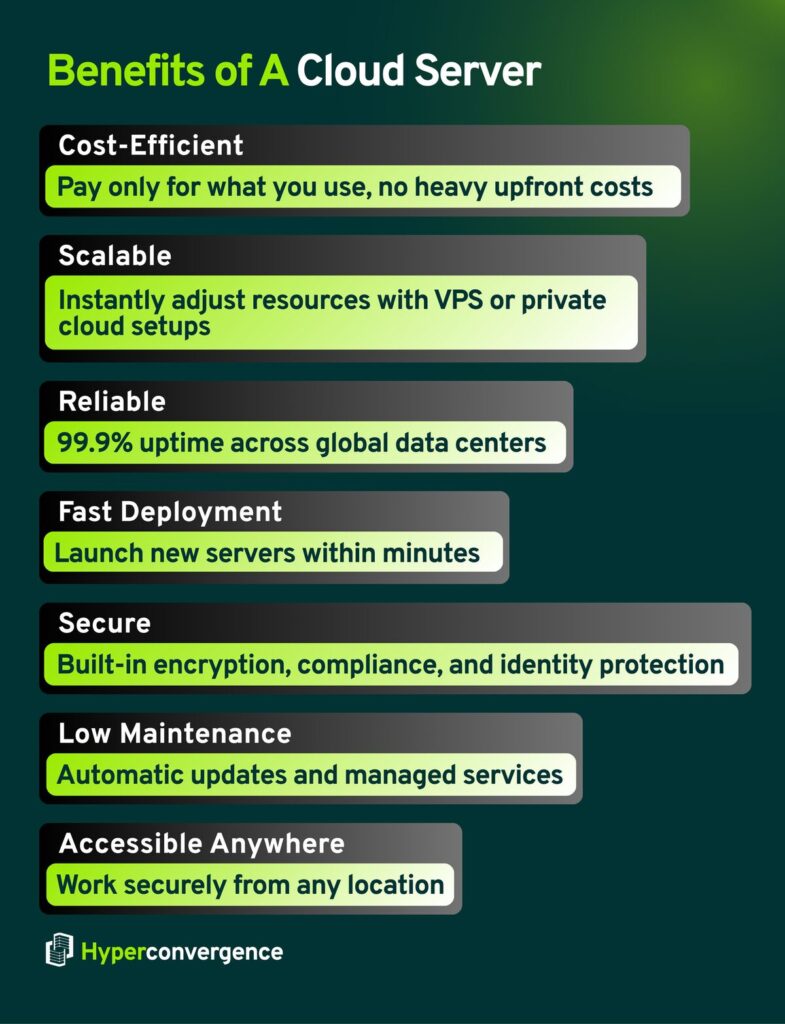
- Cost Efficiency: Cloud providers operate on a pay-as-you-go model, eliminating heavy upfront investments in hardware and maintenance. Businesses pay only for the resources they use, making budgeting easier and more predictable—whether through a shared hosting plan, VPS hosting, or dedicated hosting model.
- Scalability on Demand: VPS cloud and private cloud setups allow instant scalability to match traffic or workload changes. This flexibility helps businesses handle seasonal spikes or rapid growth without downtime.
- High Reliability: Leading CSPs like AWS, Azure, and GCP offer uptime guarantees of over 99.9% and host data across multiple regions and web servers to prevent service interruptions.
- Faster Deployment: New servers and environments can be launched within minutes, compared to weeks of procurement and setup for on-premise systems. This allows teams to innovate faster using advanced cloud server management tools and managed services.
- Enhanced Security and Compliance: Top web hosting services invest heavily in encryption, identity management, and compliance certifications, such as ISO, 27001, and SOC 2, often exceeding what individual companies can maintain in-house.
- Automatic Updates and Maintenance: Providers handle software patches, updates, and cloud management tasks, reducing IT workload and minimizing security risks.
- Global Accessibility: Cloud environments can be accessed securely from anywhere, making them ideal for remote teams and global businesses.
In short, CSPs deliver flexibility, reliability, and cost savings that traditional on-premise setups struggle to match.
The Challenges of Using CSPs
While Cloud Service Providers offer unmatched flexibility and convenience, they also come with certain challenges that you must consider before full adoption. Here are some of the most common ones:
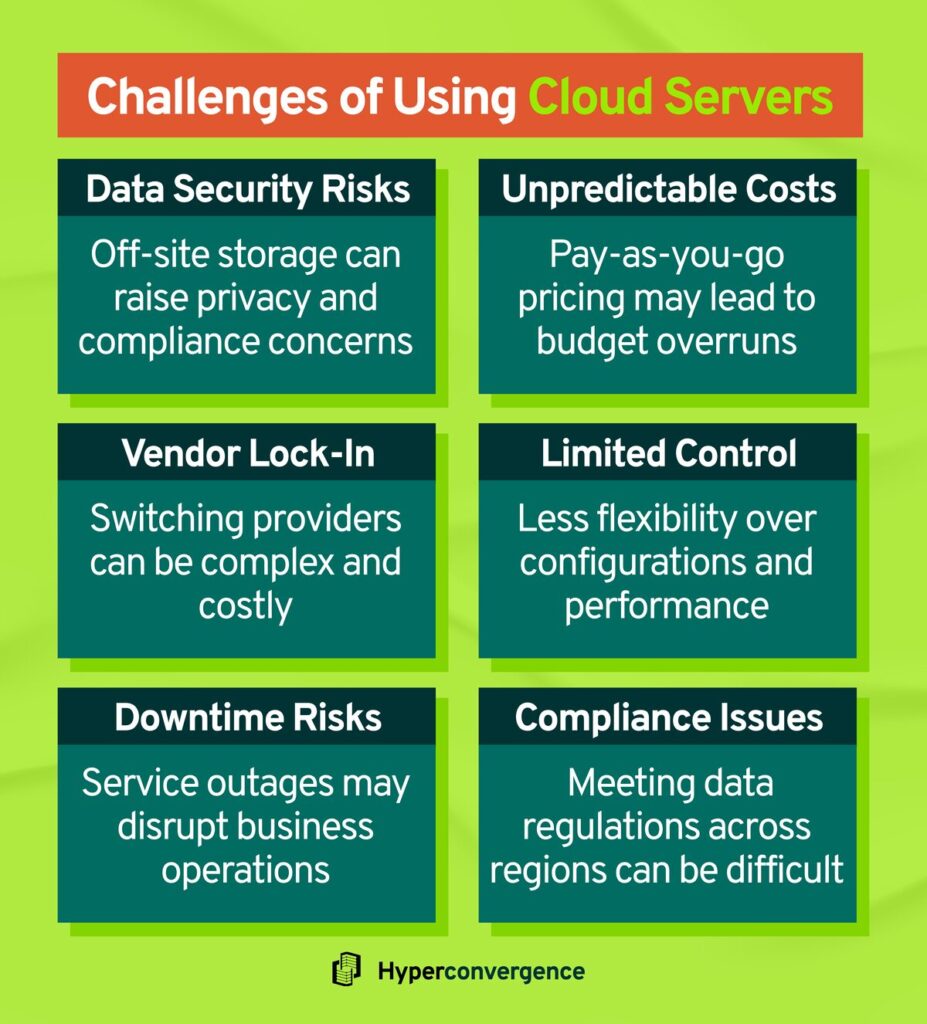
- Data Security and Privacy Concerns: Storing data off-site raises questions about access control, data ownership, and compliance. Companies using web hosting services, VPS hosting, or dedicated hosting must ensure their provider offers strong encryption, DDoS protection, and compliance with regional data laws.
- Unpredictable Costs: Although pay-as-you-go pricing is attractive, cloud costs can quickly escalate if resources are not monitored. Unexpected charges for data transfer, bare metal services, or managed services can strain budgets without proper cloud management tools in place.
- Vendor Lock-In: Migrating between CSPs can be complex and costly. Each platform offers unique management services and APIs, making transitions difficult. Businesses relying on managed WordPress or shared hosting plans often face additional challenges when trying to switch providers.
- Limited Control: Unlike on-premise setups, organizations have less visibility and control over web servers and configurations. Fine-tuning performance or adjusting settings may be restricted by provider policies, especially in fully managed services environments.
- Downtime and Service Reliability: Even top-tier CSPs occasionally face outages. Relying solely on one provider increases the risk of business disruption, especially for sites hosted under a single cloud server management framework.
- Compliance Complexities: Companies managing sensitive data across multiple regions face challenges meeting global compliance standards like GDPR or HIPAA, particularly when using cloud management platforms shared among several clients.
Despite these challenges, most businesses find that the benefits of using CSPs outweigh the drawbacks, especially when paired with proper monitoring, backup strategies, and a clear cloud governance plan.
Top 10 Cloud Servers in 2026
Here is the list of the top 10 cloud servers in 2026:
1. Amazon Web Services (AWS)
Overview
Amazon Web Services (AWS) remains the global leader among cloud servers in 2026, powering more businesses than any other provider. With a commanding 30% market share of the global cloud infrastructure market, AWS continues to set the benchmark for reliability, scalability, and innovation. Its vast ecosystem, spanning over 200 fully featured services across 30+ regions and 100+ availability zones, supports everything from startups to Fortune 500 enterprises.
It operates across 38 geographic regions and 120 Availability Zones, ensuring high performance and redundancy. (source)
Key Features
- Global Infrastructure: 30+ regions, 100+ availability zones, and 400+ edge locations ensure top-tier performance and redundancy.
- AI & Machine Learning Services: Tools like Amazon SageMaker and Bedrock help businesses build and deploy generative AI models efficiently.
- Comprehensive Service Portfolio: 200+ products covering compute (EC2), storage (S3), databases (RDS), and serverless (Lambda).
- Built-In Security & Compliance: Compliance with ISO 27001, SOC 2, GDPR, and HIPAA frameworks for enterprise-grade protection. (source)
- Flexible Pricing: Pay-as-you-go, spot instances, and reserved plans to suit diverse workloads and budgets.
Strengths
- Unmatched Scalability: Handles workloads from small websites to global enterprise systems with ease.
- Innovation Leader: Constantly expanding into AI, analytics, automation, and sustainability.
- Strong Developer Ecosystem: Vast global partner and developer network with extensive community support.
- Enterprise-Ready: Proven reliability and integration for mission-critical workloads.
Limitations
- Complex Pricing Structure: A wide service catalog can make cost estimation challenging.
- Learning Curve: Beginners may find the setup and management tools overwhelming.
- Premium Support Costs: Enterprise-level support plans can be expensive for smaller teams.
Best For: Enterprises, SaaS companies, and fast-growing startups requiring enterprise-grade performance and global reach.
Pricing Snapshot:
- AWS pricing varies by region and service; basic EC2 compute instances start around US $0.0116/hour (t4g.nano). (source)
- Options include pay-as-you-go or reserved instances for flexible budgeting
2. Microsoft Azure
Overview
This is the second-largest cloud provider globally in 2026, holding a 20% market share. It offers a comprehensive suite of cloud services, seamlessly integrating with Microsoft’s enterprise products like Office 365 and Dynamics 365. Azure’s hybrid capabilities, such as Azure Arc and Azure Stack, make it a preferred choice for enterprises seeking flexibility and control.
Key Features
- Extensive Service Portfolio: Over 200 services, including compute, storage, databases, AI/ML, and networking.
- Global Infrastructure: Operates in 70+ regions with more than 400 data centers, the most extensive global footprint among cloud providers
- Hybrid Cloud Solutions: Azure Arc and Azure Stack enable seamless integration between on-premises and cloud environments.
- AI & ML Capabilities: Integration with Microsoft’s AI tools and services for advanced analytics and machine learning applications.
- Security & Compliance: Adheres to industry standards like ISO 27001, SOC 2, and GDPR, ensuring robust data protection and compliance.
Strengths
- Enterprise Integration: Deep integration with Microsoft’s software ecosystem enhances productivity and user experience.
- Hybrid Flexibility: Strong hybrid cloud offerings cater to businesses with specific regulatory or operational requirements.
- AI Investment: Significant investments in AI infrastructure bolster Azure’s capabilities in artificial intelligence and machine learning.
Limitations
- Complex Pricing: Pricing models can be intricate, requiring careful planning and management.
- Learning Curve: New users may experience a steeper learning curve due to the breadth of services and features.
- Support Costs: Premium support options can be costly for smaller organizations.
Best For: Large enterprises, government agencies, and organizations seeking a hybrid cloud solution with strong integration into Microsoft’s ecosystem.
Pricing Snapshot:
- Virtual Machines: Pricing varies by region and instance type; for example, a Standard B1S VM in East US starts at approximately $0.008 per hour.
- Azure Free Account: Offers 12 months of popular services free and a $200 credit for the first 30 days.
3. Google Cloud Platform (GCP)
Overview
Google Cloud Platform has become a top choice for data, analytics, and AI workloads in 2026. GCP is growing fast, reaching a record quarter in 2025 with roughly 13% global market share and $13.6 billion in Q2 revenue, driven largely by demand for its AI and data services. (source)
Key Features
- AI and ML Platform: Vertex AI for model training, deployment, and MLOps.
- Data Analytics: BigQuery for fast, serverless analytics at petabyte scale.
- Compute and Serverless: Compute Engine, Cloud Run, and Kubernetes Engine for flexible workloads.
- Hybrid and Multicloud: Anthos for consistent operations across clouds and on-prem.
- Global Footprint: Wide regional coverage with many regions and zones for low latency and redundancy.
Strengths
- Analytics Excellence: Industry-leading data analytics and fast query performance.
- AI Innovation: Rapid deployment of AI/ML solutions with advanced tooling.
- Developer-Friendly: Strong open-source support and cloud-native integration for modern apps.
Limitations
- Global Reach Gaps: Some regions lack full enterprise service parity compared to AWS and Azure.
- Pricing Complexity: Cost management can be challenging for large or mixed workloads.
- Enterprise Support: Premium support options can be expensive for smaller teams.
Best For: Organizations focused on analytics, machine learning, and modern cloud-native apps that need top-tier data tooling and fast AI adoption.
Pricing Snapshot: GCP provides per-second billing for compute services. Example: e2-micro VM starts around $4–5 per month, depending on region. (source)
4. DigitalOcean
Overview
DigitalOcean is a developer-focused cloud provider popular among startups and small-to-medium businesses in 2026. Known for simplicity, predictable pricing, and fast deployments, it specializes in straightforward cloud infrastructure for web apps, small databases, and containerized workloads. Its focus on ease-of-use makes it a favorite for teams without large DevOps resources.
Key Features
- Droplets (Virtual Servers): Simple, scalable virtual machines with SSD storage.
- Managed Databases: PostgreSQL, MySQL, and Redis options with automatic backups.
- Kubernetes: Managed Kubernetes clusters for containerized applications.
- Block and Object Storage: Flexible storage solutions for apps and media.
- Marketplace Apps: Preconfigured apps and stacks for rapid deployment.
Strengths
- Ease of Use: Intuitive interface and API simplify deployment and management.
- Predictable Pricing: Transparent monthly pricing with no hidden fees.
- Fast Setup: New droplets and services can be provisioned in minutes.
Limitations
- Limited Enterprise Features: Lacks advanced analytics, AI/ML, and global-scale services compared to AWS, Azure, or GCP.
- Regional Coverage: A Smaller number of data center regions may impact latency for global audiences.
- Scaling Constraints: Best for small to medium workloads; very large enterprise workloads may face limits.
Best For: Startups, developers, and small-to-medium businesses that prioritize simplicity, cost-effectiveness, and rapid deployment.
Pricing Snapshot: DigitalOcean droplets start at $4 per month for 1GB RAM and 1 vCPU. Managed databases and Kubernetes are priced separately.
5. IBM Cloud
Overview
IBM Cloud is a strong player in the cloud space, especially when it comes to hybrid-cloud and enterprise-grade solutions. It caters particularly to industries with strict compliance and regulatory requirements (e.g., finance, healthcare, government). The platform emphasizes hybrid deployments, multi-cloud flexibility, and trusted infrastructure built around its acquisition of Red Hat and deep expertise in regulated sectors.
Key Features
- Hybrid Cloud Integration: Strong support for on-premises + cloud environments via Red Hat OpenShift and IBM’s hybrid roadmap.
- Industry-Specific Clouds: Tailored offerings for regulated industries with pre-built compliance and security frameworks.
- AI + Data Platform: Services such as watsonx. data and containerized AI workloads built into the infrastructure.
- Open-Source Friendly & Container-Ready: Strong support for Kubernetes, containers, and avoiding vendor lock-in.
- Global Infrastructure: While not as extensive as hyperscalers, IBM operates data centers and multizone regions to support enterprise workloads.
Strengths
- Compliance & Security: Built for regulated environments where data sovereignty, governance, and continuity matter.
- Hybrid & Legacy Integration: Excellent for businesses transitioning from on-premises systems to cloud, or needing a mixed model.
- Focus on Enterprise AI: Positioned for organizations deploying large-scale AI with enterprise controls and infrastructure.
Limitations
- Smaller Market Share vs Hyperscalers: IBM Cloud does not command the same broad market footprint as the top three hyperscalers.
- Complexity & Transition: Hybrid and enterprise-grade features bring complexity; they may require more time and resources to deploy effectively.
- Cost Structure: Tailored enterprise solutions often come with higher price points or less “pay-as-you-go” flexibility compared to some competitors.
Best For: Enterprises in regulated industries, organizations with existing IBM infrastructure, or those needing hybrid/sovereign-cloud architectures rather than simply public cloud scale.
Pricing Snapshot: Flexible consumption models are available (as-a-service, consumption-based) but may not offer ultra-low entry pricing compared to some competitors.
6. Alibaba Cloud
Overview
Having grown from China’s largest cloud provider to a global contender in 2026, Alibaba Cloud combines strong AI infrastructure with an expanding international reach. The company announced a multi-year investment plan worth RMB 380 billion (~US $53 billion) to boost its full-stack cloud and AI capabilities.
With new data centers planned in Brazil, France, Japan, and beyond, it’s positioning itself as a major global player.
Key Features
- AI-Driven Infrastructure: Enhanced for large-scale AI workloads with upgraded networking (HPN 8.0) and vector data storage.
- Global Expansion: New regions and availability zones planned across Asia, Europe, and Latin America.
- Hybrid & Edge Ready: Supports enterprise scenarios with cloud + edge + international footprint adaptability.
- Industry-Specific Solutions: Offers turnkey solutions for retail, e-commerce, manufacturing, and regulated sectors, leveraging a strong China presence.
- Open Ecosystem: Encourages developer adoption via its “Partner Rainforest Plan” and open-sourced models in its AI platform.
Strengths
- Innovative AI Leadership: Heavy investment and infrastructure upgrades give Alibaba Cloud an edge in AI-first workloads.
- Emerging Market Advantage: Strong positioning in Asian and emerging markets where growth is accelerating.
- Comprehensive Infrastructure: With a broad global footprint and enterprise-grade features, it appeals to businesses seeking scale with flexibility.
Limitations
- Smaller Western Market Presence: Compared to top US-based hyperscalers, its presence and brand recognition in some regions are still developing.
- Regulatory & Geopolitical Risks: As a Chinese-origin provider operating globally, it may face additional regulatory scrutiny or restrictions in certain countries.
- Complex Pricing & Service Structure: Size and scope of offerings may introduce learning curves for smaller businesses or startups.
Best For: Businesses looking for strong AI/ML capabilities, organizations expanding into or operating within Asia/EMEA regions, and enterprises that want a cloud provider with both global reach and deep local expertise in emerging markets.
Pricing Snapshot: Alibaba Cloud offers consumption-based pricing and convertibility across regions; exact rates depend heavily on region, instance type, and network usage.
7. Tencent Cloud
Overview
Backed by strong growth and strategic expansion in Asia, the Middle East, and beyond, Tencent Cloud has rapidly emerged as a major global cloud provider. The company recently announced the rollout of scenario-based AI capabilities internationally and has doubled its overseas client base year-on-year.
With operations spanning 21 regions worldwide and investment initiatives such as a new MENA region in Saudi Arabia, Tencent Cloud is setting its sights firmly on the enterprise market. (source)
Key Features
- Global Footprint & Regions: 21 geographic regions and 50 + availability zones, including a newly announced Saudi Arabia region.
- AI & Industry Solutions: Strong focus on large-model AI, “SaaS + AI” offerings, and specialized services for gaming, media, and real-time apps.
- Gaming & Media Strength-in-Depth: Named a global leader in gaming-cloud platforms for 2025, highlighting capacities in game servers, live ops, and analytics.
- Hybrid & Edge-Ready: Supports cross-region, multi-cloud, and edge scenarios, key for firms targeting emerging markets.
- Partner Ecosystem: Far-reaching partner network spanning over 30 industries, with tailored enterprise solutions.
Strengths
- Rapid Global Expansion: Accelerated growth in international markets and new regions boosts credibility and capabilities.
- AI-First Infrastructure: Designed to support next-gen AI workloads, real-time analytics, and high-concurrency applications.
- Industry-Specialized Offerings: Focus on gaming, streaming, e-commerce, and super-app ecosystems gives Tencent Cloud a unique niche strength.
Limitations
- Brand & Market Recognition Outside Asia: Still trailing the largest Western hyperscalers in certain global markets when it comes to enterprise positioning.
- Region/Sector Nuances: Some enterprise deployments may face regulatory, data-sovereignty, or localization challenges depending on the geography.
- Complex Pricing & Support Landscape: As with many global growth players, exploring full-service tiers and support options may require more due diligence.
Best For:
- Companies expanding into Asia-Pacific, the Middle East, or emerging markets;
- Gaming or media firms needing global low-latency performance;
- Firms seeking AI-powered, edge-enabled cloud infrastructure with hybrid capability.
Pricing Snapshot: Regional pricing varies considerably; enterprises should contact Tencent Cloud sales for tailored quotes for global or high-performance workloads.
8. Kamatera
Overview
Kamatera is a nimble yet powerful cloud service provider offering highly customizable infrastructure and rapid scalability at competitive pricing. Featuring global data centers and modern hardware, Kamatera appeals to startups and established businesses looking for cloud performance without rigid configurations. For example, they offer hourly billing models, support for multiple operating systems, and claim an uptime guarantee of 99.95%.
Key Features
- Customized Server Build: You can choose vCPU, RAM, NVMe SSD storage, OS, and location from a self-service portal.
- Instant Scaling: Upgrade (or downgrade) server specs in minutes, adapt to demand without long-term commitments.
- 45+ Global Locations: Deploy servers near your users for low latency and redundancy across continents.
- Flexible Pricing: Both hourly and monthly billing options are available; pay only for what you use.
- 24/7 Support & Monitoring: Around-the-clock human support plus monitoring tools, alerts, and audit-ready logs.
Strengths
- Adaptability & Control: A high level of customization means you get exactly the resources you need.
- Lower Entry Cost: Because you can start small and scale up, it’s ideal for smaller businesses or test environments.
- Global Reach for Less: Strong infrastructure in multiple regions, making it easier to serve international users.
Limitations
- Less Brand Recognition: Compared to the top hyperscalers (e.g., AWS, Azure, GCP), Kamatera has less enterprise mind-share.
- Focus on Self-Service: While the flexibility is great, it may require more IT skills compared to fully-managed offerings.
- Support Variety: Premium support levels may cost extra for very large-scale or complex enterprise needs; other providers may offer more specialized solutions in comparison.
Best For: Growing businesses, SaaS providers, web-hosting companies, and developers who want full control over their cloud stack, need rapid scaling, and value cost transparency and global reach.
Pricing Snapshot:
- Entry server: From about US$4/month for a basic configuration (1 vCPU, 1 GB RAM, 20 GB NVMe) according to their pricing page.
- Billing options: Pay-as-you-go hourly or monthly subscription, with full flexibility to upgrade.
9. Vultr
Overview
Vultr has become one of the most popular independent cloud providers in 2026, known for its simplicity, affordability, and developer-friendly design. Headquartered in the U.S., Vultr now operatesover 32 cloud data centers worldwide, making it a serious alternative to major hyperscalers for businesses seeking performance without complexity. Its core appeal lies in offering high-performance compute instances, bare-metal servers, and Kubernetes clusters- all deployable in seconds.
Key Features
- Global Reach: 32+ data centers across 6 continents for low-latency access and redundancy.
- Optimized Cloud Compute (OCC): NVMe-based storage and AMD EPYC / Intel Xeon CPUs deliver ultra-fast processing.
- Kubernetes & Bare Metal: Fully managed Kubernetes service and dedicated bare-metal servers for demanding workloads.
- API & Automation: Simple APIs, Terraform support, and developer tools for quick provisioning.
- Transparent Pricing: Straightforward hourly and monthly pricing with no hidden costs.
Strengths
- Developer-Centric Platform: Intuitive UI and API make setup fast and flexible for developers and SMEs.
- Affordable Performance: Competitive pricing with high compute value; ideal for small businesses and startups.
- Global Expansion: Extensive worldwide footprint ensures high-speed content delivery and data proximity.
Limitations
- Limited Enterprise Integrations: May lack the depth of AI, analytics, and compliance tools offered by larger hyperscalers.
- Basic Support Tiers: Premium support costs extra, which can be limiting for critical workloads.
- Less Ecosystem Depth: While great for infrastructure, it lacks the broader SaaS / PaaS ecosystem found in AWS or Azure.
Best For: Startups, SaaS providers, and developers who need affordable, fast, and globally distributed compute without enterprise-level complexity.
Pricing Snapshot:
- Standard cloud instances start from US $5/month for 1 vCPU + 1 GB RAM.
- Pay-as-you-go billing with easy scaling and no contracts.
10. Cisco Cloud Solutions
Overview
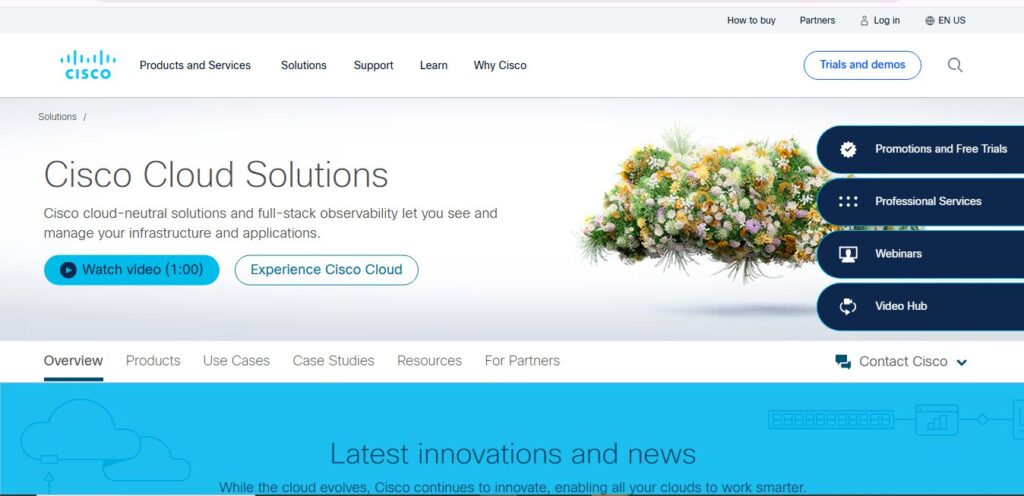
Cisco Cloud Solutions continues to be a trusted choice for enterprises seeking secure, hybrid, and AI-ready cloud infrastructure. Built around its flagship Cisco Cloud Infrastructure and Cisco Cloud Security portfolios, the company focuses on enabling digital transformation through multi-cloud and networking excellence. Cisco’s strength lies in connecting hybrid environments seamlessly, linking public, private, and edge workloads under one secure ecosystem.
Key Features
- Hybrid & Multi-Cloud Connectivity: Cisco’s cloud services integrate across AWS, Azure, and GCP, helping enterprises unify workloads.
- Cloud-Native Security: Includes Cisco Secure Cloud and ThousandEyes for visibility, monitoring, and zero-trust protection.
- AI-Driven Networking: Cisco’s AI-powered observability and automation tools enhance application performance across multi-cloud environments.
- Edge Computing Integration: Designed for IoT and real-time analytics through Cisco Edge Cloud Services.
- Sustainability & Compliance: Built to meet international compliance standards and reduce operational carbon footprint.
Strengths
- Enterprise Reliability: Backed by decades of networking expertise and enterprise-grade support.
- Seamless Hybrid Operations: Simplifies managing complex multi-cloud networks and applications.
- Security Leadership: Cisco’s zero-trust and threat-detection solutions make it a top pick for security-conscious industries.
Limitations
- Not a Standalone Public Cloud: Cisco’s focus is more on enabling, managing, and securing other clouds rather than offering a full-fledged hyperscaler alternative.
- Higher Cost for SMBs: Enterprise-level packages and tools may be less accessible to smaller businesses.
- Complex Deployment Options: Integration and configuration may require advanced IT expertise.
Best For: Large enterprises, government agencies, and organizations with hybrid or multi-cloud environments that require top-tier networking, visibility, and cybersecurity.
Pricing Snapshot: Cisco Cloud Solutions offer custom enterprise pricing based on use case, region, and scale. Businesses can request tailored quotes through Cisco’s partner network or official site.
Comparative Analysis based on Pricing and Performance
Now, let’s review the highlighting points for each cloud server to compare their price and performance:
| 1. Amazon Web Services (AWS) | Global Reach: 38 regions, 120+ availability zones, 400+ edge locations Performance: 99.99% uptime AI & ML: SageMaker, Bedrock for AI and generative AI Scalability: Excellent vertical & horizontal scaling Security & Compliance: ISO 27001, SOC 2, HIPAA Ease of Use: Moderate learning curve, strong documentation & community Pricing: ~$0.0116/hour (EC2 t4g.nano), pay-as-you-go or reserved Free Tier: ✅ 12 months for new users Customer Support: 24/7 premium support available Best For: Enterprises, SaaS companies, data-intensive workloads Notable Strength: Market leader with a massive ecosystem and global coverage |
| 2. Microsoft Azure | Global Reach: 70+ regions, 400+ data centers (largest footprint among cloud providers) Performance: 99.99% uptime AI & ML: Azure AI, OpenAI integration, advanced analytics Scalability: Excellent, strong hybrid and multi-cloud support via Azure Arc and Azure Stack Security & Compliance: ISO 27001, SOC 2, GDPR Ease of Use: Moderate; integrates deeply with Microsoft ecosystem (Office 365, Dynamics 365) Pricing: ~$0.008/hour (Standard B1S VM), pay-as-you-go or reserved Free Tier: ✅ 12 months of popular services + $200 credit for first 30 days Customer Support: 24/7 via Azure portal or partner network Best For: Large enterprises, government agencies, hybrid-cloud organizations Notable Strength: Deep Microsoft integration and hybrid cloud flexibility |
| 3. Google Cloud Platform (GCP) | Global Reach: 40+ regions, multiple availability zones for low latency and redundancy Performance: 99.99% uptime AI & ML: Vertex AI for model training, deployment, and MLOps Data & Analytics: BigQuery for serverless analytics at petabyte scale Compute & Serverless: Compute Engine, Cloud Run, Kubernetes Engine for flexible workloads Hybrid & Multicloud: Anthos enables consistent operations across clouds and on-premises Security & Compliance: ISO 27001, GDPR Ease of Use: Developer-friendly, strong cloud-native, and open-source support Pricing: e2-micro VM starts ~$4–5/month, per-second billing Free Tier: ✅ Free tier + $300 credit for new users Customer Support: 24/7 support plans available Best For: Analytics-driven organizations, AI/ML workloads, cloud-native apps Notable Strength: Industry-leading analytics, AI tools, and fast deployment |
| 4. DigitalOcean | Global Reach: 15+ regions worldwide Performance: 99.95% uptime AI & ML: Limited AI/ML offerings Compute & Serverless: Droplets (virtual servers), Kubernetes clusters for containerized apps Managed Databases: PostgreSQL, MySQL, Redis with automatic backups Storage: Block storage and object storage for apps and media Ease of Use: Very simple interface and API, ideal for small teams Pricing: Droplets start at ~$4/month (1 vCPU, 1 GB RAM) Free Tier: ✅ Free trial credits available Customer Support: Email and ticket support; premium support available Scalability: Moderate; best for SMBs and small workloads Best For: Startups, developers, and small-to-medium businesses Notable Strength: Simplicity, predictable pricing, fast deployment |
| 5. IBM Cloud | Global Reach: Multi-zone regions worldwide Performance: 99.99% uptime AI & ML: watsonx.ai platform for AI workloads and analytics Hybrid Cloud Integration: Strong support via Red Hat OpenShift and a hybrid deployment roadmap Industry-Specific Clouds: Tailored solutions for regulated sectors like finance, healthcare, and government Open-Source & Container-Ready: Kubernetes and container support, avoids vendor lock-in Security & Compliance: ISO 27001, SOC 2, GDPR Ease of Use: Moderate; best for enterprises with existing IBM infrastructure Pricing: Flexible consumption-based or as-a-service models Free Tier: ✅ Lite plans available for certain services Customer Support: 24/7 enterprise-grade support Scalability: Good; supports enterprise-scale hybrid workloads Best For: Enterprises in regulated industries, hybrid-cloud users, organizations needing secure and compliant infrastructure Notable Strength: Enterprise-grade compliance, hybrid flexibility, strong AI platform |
| 6. Alibaba Cloud | Global Reach: 30+ regions worldwide, expanding internationally Performance: 99.99% uptime AI & ML: PAI platform and ModelScope for AI workloads Hybrid & Edge Ready: Supports enterprise, cloud + edge scenarios Industry Solutions: Turnkey offerings for retail, e-commerce, manufacturing, and regulated sectors Open Ecosystem: Developer-friendly with Partner Rainforest Plan Security & Compliance: ISO 27001, SOC2 Ease of Use: Moderate; growing global presence Pricing: Consumption-based; varies by region and instance type Free Tier: ✅ Free trial available Customer Support: Regional support centers and chat Scalability: Excellent; suited for enterprise growth Best For: AI/ML workloads, Asia/EMEA enterprises, global expansion Notable Strength: Strong AI capabilities and emerging-market advantage |
| 7. Tencent Cloud | Global Reach: 21 regions, 50+ availability zones; new MENA region in Saudi Arabia Performance: 99.95% uptime AI & ML: Large-model AI, SaaS + AI offerings Industry Focus: Gaming, media, e-commerce, real-time apps Hybrid & Edge Ready: Supports cross-region, multi-cloud, and edge deployments Partner Ecosystem: Covers 30+ industries with tailored enterprise solutions Security & Compliance: ISO 27001 certified Ease of Use: Moderate; strong regional support Pricing: Regional, enterprise-focused; contact sales for custom quotes Free Tier: ✅ Free trial credits available Customer Support: Dedicated enterprise and regional support Scalability: High; suitable for global low-latency performance Best For: Gaming/media companies, AI-driven workloads, firms expanding in Asia/MENA Notable Strength: Rapid global expansion with AI-first infrastructure |
| 8. Kamatera | Global Reach: 45+ locations worldwide Performance: 99.95% uptime AI & ML: Basic support; not specialized Customizable Infrastructure: Choose vCPU, RAM, NVMe SSD, OS, and location Instant Scaling: Upgrade or downgrade server specs in minutes Flexible Pricing: Hourly or monthly billing; pay only for what you use Support: 24/7 live chat, monitoring, and alerts Security & Compliance: ISO 27001 certified Ease of Use: Moderate; self-service platform Pricing: Entry server ~$4/month (1 vCPU, 1 GB RAM, 20 GB NVMe) Free Tier: ❌ No free tier Scalability: High; rapid scaling for growing businesses Best For: Startups, SaaS providers, web-hosting companies, developers Notable Strength: Highly customizable with global reach at competitive pricing |
9. Vultr | Global Reach: 32+ data centers across 6 continents Performance: 99.99% uptime Compute & Serverless: High-performance compute instances, Kubernetes clusters, bare-metal servers Developer Tools: Simple API, Terraform support, fast provisioning Storage: NVMe-based storage for ultra-fast processing Pricing: Standard cloud instances start at $5/month (1 vCPU, 1 GB RAM) Free Tier: ❌ No permanent free tier Support: Email and ticket support; premium support available Security & Compliance: ISO 27001 certified Ease of Use: Very developer-friendly Scalability: Moderate; suitable for startups and SMBs Best For: Startups, SaaS providers, developers needing affordable, fast, globally distributed compute Notable Strength: Affordable, high-performance infrastructure with global reach |
| 10. Cisco Cloud Solutions | Global Reach: Hybrid and multi-cloud connectivity across AWS, Azure, GCP Performance: 99.99% uptime Compute & Networking: AI-driven observability, automation, and edge computing integration Security & Compliance: Zero-trust architecture, Cisco Secure Cloud, international compliance standards Hybrid & Multi-Cloud: Seamless management of public, private, and edge workloads AI & Analytics: AI-powered monitoring for application performance Pricing: Custom enterprise pricing; contact Cisco for quotes Free Tier: ❌ No free tier Support: 24/7 enterprise support through partner network Ease of Use: Moderate; requires IT expertise for deployment Scalability: High; ideal for large-scale hybrid environments Best For: Large enterprises, government agencies, security-conscious organizations Notable Strength: Enterprise-grade networking, hybrid cloud expertise, and security leadership |
How Do You Choose the Best Cloud Service Provider? Factors to Consider
Selecting the right cloud hosting provider can shape your business’s performance, scalability, and long-term growth. While most hosting companies offer similar services, understanding the core factors that differentiate them helps identify the best cloud hosting providers for your specific needs.
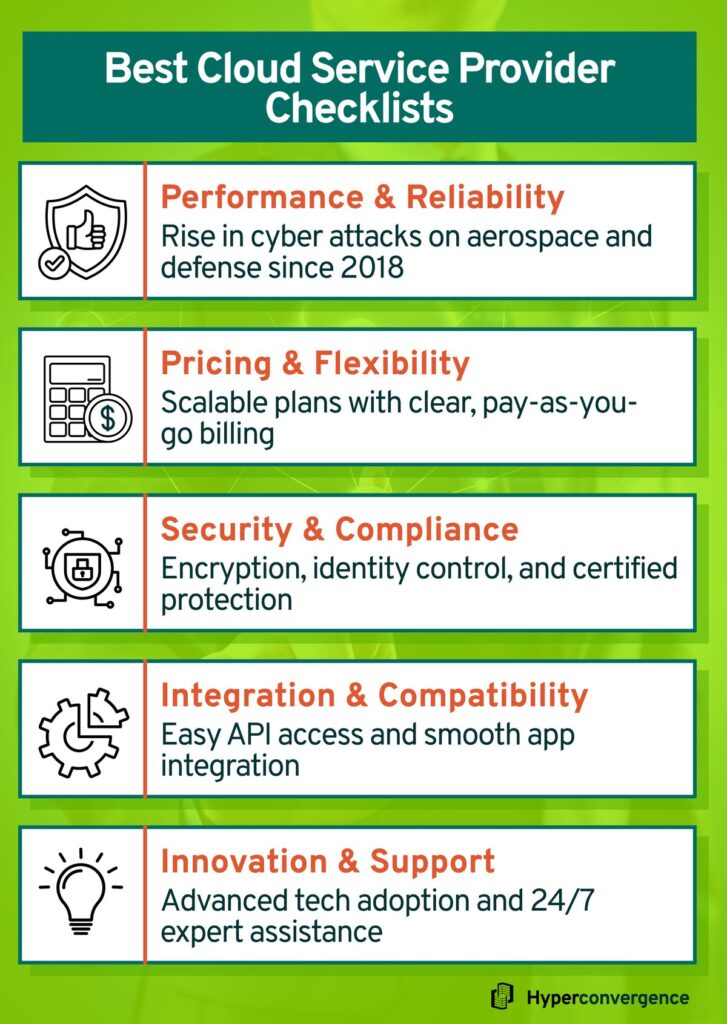
1. Performance and Reliability:
Look for cloud hosting providers that maintain a robust infrastructure, multiple data centers, and strong uptime guarantees. These factors directly influence speed, availability, and overall user experience.
2. Pricing and Flexibility:
Compare cloud hosting plans based on scalability, pay-as-you-go options, and transparent billing. Some providers offer both shared hosting plans for smaller projects and private cloud options for businesses that need greater control and security.
3. Security and Compliance:
Choose a provider with advanced encryption, identity management, and compliance certifications. Reliable management services and cloud management tools should support your data protection strategy.
4. Integration and Compatibility:
The best cloud hosting services integrate easily with existing applications and software as a service (SaaS) platforms. Ensure your provider supports APIs and hybrid setups to simplify migration and scalability.
5. Innovation and Support:
Evaluate how providers adopt emerging technologies such as AI, edge computing, and containerization to drive operational efficiency. Round-the-clock customer support and proactive monitoring are equally vital for long-term reliability.
In short, the best cloud hosting providers offer scalable performance, transparent pricing, and dependable support- all essential for growing in today’s fast-moving digital ecosystem.
Top 3 Biggest Cloud Providers by Market Share (2026)
As of 2026, the top 3 leading cloud service providers continue to dominate the global market through innovation and effective cloud server management. Amazon Web Services (AWS) holds the top spot with around30% market share, followed by Microsoft Azure at 20%, and Google Cloud Platform (GCP) at 13%. Together, they account for about63% of worldwide cloud infrastructure spending. (source)
These providers drive progress in emerging technologies such as AI, data analytics, and edge computing, helping businesses enhance scalability and operational resilience through advanced cloud server management tools.
| Top 3 Cloud Service Providers | Market Share in 2026 |
| 1. Amazon Web Services | 30% |
| 2. Microsoft Azure | 20% |
| 3. Google Cloud Platform | 13% |
The Future of Cloud Computing in 2026
In 2026, cloud computing continues to evolve as businesses demand more flexible and scalable web hosting services. The focus is shifting toward hybrid cloud environments, where companies balance the security of private clouds with the scalability of public clouds. As managed cloud hosting becomes mainstream, businesses are increasingly relying on multiple servers to optimize cloud resources across different regions.
Traditional shared and VPS hosting are being replaced by dynamic cloud hosting plans designed for better control and cost efficiency.
- By 2030, the U.S. cloud computing market will reach USD 813.01 billion, with a CAGR of 20.3%.
- Separately, cloud infrastructure (hardware and networking underpinning cloud services) is projected to grow by 123% from $294.99 billion in 2025 to $837.97 billion by 2034, with a CAGR of 12.3%.
With cloud computing revenue projected to more than double over the next decade, businesses that adopt hybrid cloud environments, managed cloud hosting, and scalable cloud hosting plans will be best positioned to leverage the next wave of digital innovation.
The Bottom Line
Finding the right cloud service provider is all about balancing performance, cost, and control. The best cloud hosting services deliver reliability, scalability, and intelligent cloud server management to power your business without the technical stress. Whether you’re running multiple websites, managing your own servers, or relying on fully managed solutions, modern cloud management tools make it easy to optimize server resources and monitor workloads in real time.
If you’re just starting out, providers like DigitalOcean and Kamatera offer cost-effective, developer-friendly environments with flexible virtual private servers and simple scaling. For large enterprises or growing SaaS businesses, AWS and Microsoft Azure remain top choices, offering dedicated servers, global reach, and custom solutions tailored to complex workloads. Some even include free hosting tiers- perfect for testing before committing long-term.
In the end, the best choice depends on your needs. Compare each provider’s offerings, consider your goals, and select the managed hosting plan that gives you the right mix of control, performance, and peace of mind.
FAQs
The top 3 cloud service providers in 2026 are Amazon Web Services (AWS), Microsoft Azure, and Google Cloud Platform (GCP). They dominate global cloud hosting services with a 63% market share with the help of advanced AI tools, scalable infrastructure, and powerful cloud management solutions.
Amazon Web Services (AWS) owns the largest global network of cloud servers, spanning over 30 regions and 100+ availability zones. It leads in infrastructure as a service (IaaS), powering millions of web hosting services and enterprise workloads worldwide.
No, cloud computing and AI complement each other. AI needs the scalable cloud resources and processing power that cloud platforms provide. Together, they enhance managed cloud hosting, automation, and cloud cost intelligence platform capabilities.
AWS remains the most popular cloud hosting service in 2026 due to its reliability, scalability, and vast ecosystem. It offers flexible VPS plans, dedicated servers, and managed services for both startups and enterprises.
Experts project the global cloud computing market to exceed $1.6 trillion by 2030, driven by hybrid deployments, multi-tenant environments, and next-gen cloud management and AI-driven optimization tools.
Yes. Many cloud hosting services like AWS, Azure, and Google Cloud offer free hosting tiers or trial credits for limited cloud resources, perfect for testing hosting plans or small projects.
Absolutely. Cloud servers are built for instant scalability, allowing you to increase or reduce server resources anytime. Both VPS plans and dedicated hosting support flexible growth with minimal downtime.
AWS and Microsoft Azure are considered the most reliable cloud service providers in 2026, offering global uptime guarantees, advanced managed cloud hosting, and enterprise-grade infrastructure as a service.
DigitalOcean, Kamatera, and Vultr are great for startups, offering affordable VPS plans, managed hosting, and transparent pricing. They’re ideal for teams that want flexible scaling without complex hosting services.
Relying on one provider limits flexibility and may raise cloud costs or create downtime risks. A multi-cloud or hybrid setup helps balance cloud resources, improve reliability, and optimize hosting plans across multiple providers’ offerings.
[…] top cloud servers guide provides a product-oriented view of this […]